Monday, December 04, 2006

Leadership that embraces Humanity

Discussions on the interpretation of Christ “being found in appearance as a man” (σχήματι εὑρεθεὶς ὡς ἄνθρωπος) in the Philippians hymn has been traditionally riddled with controversy and rigorous debate (Howard 1978, 368). Re-reading the hymn as an ethical exemplum has opened a new and promising avenue for a discussion on the social values that the hymn proposes in a society riddled with social inequalities and thus holds many practical applications for Christian leadership. Albert Nolan (1977, 135), in his response to apartheid in South Africa, used the Philippians hymn to construct a new perspective in ontological Christology that demands a new appreciation of the humanity of Christ and thus of others:

“Whatever humanity and divinity may mean in terms of a static philosophy of
metaphysical natures, in religious terms for the man who recognizes Jesus as
his God, the human and the divine has been brought together in such a way
that they now represent one and the same religious value. In this sense
Jesus’ divinity is not something totally different from His humanity. Jesus’
divinity is the transcendent depth of His humanity. Jesus was immeasurably
more human than other men…”

Regardless of some of the obvious theological difficulties of some of Nolan’s arguments, his Christology does open exciting possibilities in ethical discussions in leadership and service.

In embracing the His own humanity and thus the humanity of others, Jesus “redefined neighbor in terms of praxis, not propinquity” (Sorenson 2004, 461). This “praxis” is one of charity, identification with the one being served and of authentic love. Vanstone (1978) has developed a phenomenology of love in which he characterizes three characteristics of authentic love (Gregerson 2003, 371-372). Authentic love is limitless, precarious and vulnerable (Vanstone 1978, 44-51).
  • Authentic love therefore does not impose boundaries on others (limitless) but “accepts without limit the discipline of the circumstances” (Vanstone 1978, 44),

  • is precarious in that it avoids the “the distortion of possessive control” (Gregerson 2003, 372)

  • and finally true love revels in being vulnerable in that it gives the one loved a “power that could not otherwise be there” (Vanstone 1978, 51).

Christian Leadership that takes the call to Christological mimesis seriously will exhibit this embracing of humanity in love that is limitless, precarious and vulnerable.

Further Reading:

Howard, G. 1978. Phil. 2:6-11 and the Human Christ. Catholic Biblical Quarterly 40(3): 368-387.

Nolan, A. 1977. Jesus before Christianity. Cape Town: David Phillips.

Sorenson, R. L. 2004. Kenosis and Alterity in Christian Spirituality. Psychoanalytic Psychology. Vol. 21, No. 3, 458-462.

Vanstone, W. H. 1978. The Risk of Love. New York: Oxford University Press.

Thursday, November 30, 2006

The Dark Night of the Soul

I am presenting a lecture later today on the approach to spiritual direction of the Spanish Reformers of the 15th century: John of the Cross and Teresa of Avila. John of the Cross remains an important guide in the quest for authentic Christian formation and thus leadership.

John's image of the "dark night of the soul" as a necessary step in our formation and journey towards God stands unmatched. He says it best in his famous poem:

One dark night, fired with love's urgent longings
ah, the sheer grace!
I went out unseen, my house being now all stilled.
In darkness, and secure, by the secret ladder, disguised
ah, the sheer grace!
in darkness and concealment, my house being now all stilled.
On that glad night, in secret, for no one saw me,
Nor did I look at anything, with no other light or guide than the one that burned in my heart
This guided me more surely than the light of noon
To where He was awaiting me
Him I knew so well
there in a place where no one appeared
O guiding night!
O night more lovely than the dawn!
O night that has united the Lover with his beloved,
transforming the beloved in her Lover.
Upon my flowering breast, which I kept wholly for Him alone,
There He lay sleeping, and I caressing Him there in a breeze from the fanning cedars.
When the breeze blew from the turret, as I parted His hair,
It wounded my neck with its gentle hand, suspending all my senses.
I abandoned and forgot myself,
laying my face on my Beloved.
All things ceased; I went out from myself, leaving my cares forgotten among the lilies.

Wednesday, November 29, 2006

Silence and Leadership

I am re-reading portions of the Philokalia (the Sayings of the Desert Fathers and Mothers) as part of my morning devotions and am struck once again by the centrality that these sayings give to ethical conduct in leadership. The connection between the "control of the tongue" and ethical conduct is often made by these early Christian hermits. Two stories from this time will suffice to illustrate this point:

Abba Isidore of Pelusia said: Living without speaking is better than speaking without living. For a person who lives rightly helps us by silence, while one who talks too much merely annoys us. If, however, words and life go hand in hand, it is the perfection of all philosophy.

Abba Poemen said: There is one sort of person who seems to be silent, but inwardly criticizes other people. Such a person is really talking all the time. Another may talk from morning to night, but says only what is meaningful, and so keeps silence.

May we learn the wisdom of silence.

Tuesday, November 28, 2006

To be a Disciplined Disciple

I am reminded this morning of the semantic similarity between the concepts of discipline and disciple. To be a disciple/follower of Jesus is to live a disciplined life. Thomas Merton describes this commitment to a disciplined life in the language of the appropriation of the cross of Jesus. To experience the "discipline of the cross" is to move from an ego-affirming spirituality to an ego-transcended approach to life and leadership. The contributions that this make in our search for authentic leadership are obvious.
Merton writes:
“But basically, the discipline involved here is that of a crucifixion which eliminates a superficial and selfish kind of experience and opens to us the freedom of a life that is not dominated by egoism, vanity, willfulness, passion, aggressiveness, jealousy, greed. Finally, discipline means solitude of some sort, not in the sense of selfish withdrawal but in the sense of an emptiness that no longer cherishes the comfort of various social ‘idols” and is not slavishly dependent on the approval of others. In such solitude one learns not to seek love but to give it. One’s great need is now no longer to be loved, understood, accepted, pardoned, but to understand, to love, to pardon and accept others just as they are, in order to help them transcend themselves in love.”

Source:
Thomas Merton. “Renewal and Discipline” in Contemplation in A World of Action (New York, Doubleday and Company, Inc.): 131-132.

Monday, November 27, 2006

Winning at any Cost?

I have been travelling, speaking and ministering for the last month, and so have not had the oppertunity to blog. This has been a providential time for me with lots of time for prayer, study and reflection. I continue to be taken by the extra-ordinary levels of competitiveness amongst Christian leaders. We compare and compete with one another and in a mad rush for legitimacy construct elaborate systems/ideologies that ensure that the world and the church know/acknowledge that we are the best, the greatest and on top. We parade our strengths, list our accomplishments, argue how only "our group/ordinations" can be traced back to the early Church (and thus to Jesus) and conduct an endless advertisement campaign to prove that all others are wrong and we are right. I wonder how this is different to the current "war" between certain fanatic Islamic groups and the Western world. But is it really about "winning"? Where is the "signature" of Jesus in the church and larger world today? How can we mirror the love, mercy and salvation that Jesus offers, if our greastest value is triumphing over others?
The Franciscan singer, song-writer and leader, John Michael Talbot writes in his Thanksgiving Letter to his Community about the need for authentic Christian leadership: "If we truly began to grasp the meaning of what it is to be 'Christian,' or 'like Christ,' we would shake the world, and in a good way! A revolution of Love would spread across the planet like a healing fire, and across the oceans like a life-giving tsunami! For the authentic follower of Jesus, this is done by really giving witness to Jesus, not through religious fundamentalism and fanaticism, but through a radicalism (or rootedness) that is willing to truly live the way that Jesus lived. Jesus changed the world with only 12 apostles. Are there twelve who will respond, or 120, 12,000, or 12 million? What would happen if we would all dare to do this? We would change the world, and for the better."
The only one that never suffered from a messianic complex was the one that was/is the Messiah.
Picture:
Brett Murray (2005): "Our religion must win". Goodman Gallery.

The Future according to Jesus

I got word last week, whilst travelling in South Africa, that our proposal for a panel presentation on the future acoording to Jesus at the World Future Association's International Conference in 2007 has been accepted. Lots of thanks and appreciation go to Jay Gary (PeakFutures, Colorado Springs: USA) and Tsvi Bisk (Center for Strategic Futurist Thinking, Jerusalem: Israel) for graciously inviting me to do this presentation with them. Here is an abstract of our presentation:

The Future According to Jesus
Futurists often encounter religionists who hold views that undercut future-oriented behavior, including determinism, fatalism, or millennial beliefs. But as a Palestinian Jew, what was Jesus’ real view of the future? And how does that view compare with that of futurists who focus on “this world,” rather than the next? Drawing on historical Jesus research, this session identifies three driving forces of the first century, and argues that Jesus rejected the conventional and counter-futures of His time to envision a creative future for His generation. This first-century foresight will then be compared and contrasted with 21st century global scenario frameworks to consider how visionary leadership might shift society's deeply ingrained attitudes toward impending conflicts and catastrophes.

Who should attend: Any futurist who has encountered resistance to futures thinking from religionists.


What you’ll learn: Participants will learn how to ground foresight in the historical world of Jesus, and relate religious concepts to futures thinking and contingency planning.


How this knowledge can be applied: Attendees will learn how to generate “third way” scenarios that seek to transcend the clash of mainstream and side stream futures.

Monday, October 30, 2006

Developments in African Leadership

I am chairing another panel presentation (this week at the International Leadership Assocation [ILA] Conference in Chicago) on African Models of Leadership entitled, "Developments in African Leadership: A Renaissance of Values-based Leadership Approaches", with Drs. Jeff Hale, Kathleen Patterson and Bruce Winston. Here follows an abstract of the presentation:

In this session, four papers present a survey of values-based approaches in contemporary African leadership. Bekker illustrates how the African practice of affective community and fundamental humanity in the Southern African social philosophy of ubuntu allows for the construction of a value–based approach of leadership in post-apartheid South Africa where leader and follower attain full humanity through a liberative, empowering relationship of mutuality. Hale proposes a theoretical model of cross-cultural leadership in West-Africa. The model proposed in this presentation unfolds from the literature relating to the current leadership crises in West Africa, West African culture, West African leadership, Servant Leadership Theory, and Transformational Leadership Theory. Generalized characteristics derived from the literature review described West African culture and leadership. An analysis of these general characteristics yields a composite list of West African leadership characteristics. These characteristics harmonize and integrate with the variable sets of servant leadership, transformational leadership, and principles of spiritually/divinely empowered leadership. Patterson’s presentation is a research report on servant leadership, specifically considering servant leadership theory in a Kenyan context with a focus on the Swahili concept of Harambee, meaning pulling together and embodies and reflects the value of mutual assistance, joint effort, mutual social responsibility, and community self-reliance. And, finally, Winston presents a case study of a South African fast-food company exploring the deliberate use of paternalistic/clan leadership style at the store level, a transactional leadership style at the store manager to regional manager level, and a transformational leadership style between the CEO and his direct reports at the head offices.

Towards an Understanding of Leadership and Spirituality

I am chairing a panel entitled "Towards an Understanding of Leadership and Spirituality", this week at the International Leadership Association (ILA) Conference in Chicago, with Drs. Diane Chandler, Michael Hartsfield and Karin Klenke. Here is an abstract of the session:

In this session, four papers present some of the current topics and themes that deal with research in the field of Leadership and Spirituality. Bekker proposes that the ethical and theological concept of kenosis (voluntary self-emptying) provides leaders with an alternative approach to the power games of contemporary corporate leadership. Such a kenotic approach to leadership requires a resolute divesting of prestige and power and in doing so enable the leader and follower to enter into a new relationship marked by radical equality and self-sacrificial service. Chandler reports that work overload is a casualty of the modern workplace, with leadership burnout being an unfortunate result. Chandler explores how spirituality contributes to both resilience and well-being and also impacts burnout within one group of working professionals. Hartsfield illustrates that sustainable improvement in individual and organizational performance results from leaders connecting with followers at a deeper spiritual and emotional level. This presentation considers the risk this emotional labor represents to long-term effectiveness of leaders whose leadership style is marked by a deep emotional investment in followers. And finally, Klenke presents a theoretical model that integrates leadership and spiritual development. This model draws from authentic, spiritual, self-sacrificial and the life stream model. The paper concludes with recommendations for empirical research.

Sunday, October 29, 2006

The Deceit of Pride

Pride is deceitful. A telling old Jewish joke shows the changing face of pride. In the village synagogue, during the High Holidays, the rabbi prostrates himself on the floor, saying, "God, before You I am nothing." Immediately the richest man in town prostrates himself on the floor, saying, "God, before You I am nothing." Right after that the town beggar prostrates himself on the floor, saying, "God, before You I am nothing." The rich man whispers to the rabbi,"Look who thinks he's nothing."

Dr. Paul Wong, Professor at Western Trinity University proposes the following practices in the pursuit of humilty, practices that I think translates very well to organizational leadership behavior:

* Acknowledging our wrong doing

* Receiving correction and feedback graciously

* Refraining from criticizing others

* Forgiving others who have wronged us

* Apologizing to others who have been wronged by us

* Enduring unfair treatments with patience and a forgiving spirit

* Thinking and speaking about the good things of other people

* Rejoicing over other people's success

* Counting our blessings for everything, good and bad

* Seeking opportunities to serve others

* Willing to remain anonymous in helping others

* Showing gratitude for our successes

* Giving due credit to others for our successes

* Treating success as a responsibility to do more for others

* Willing to learn from our failures

* Assuming responsibility for our failures

* Accepting our limitations and circumstances

* Accepting social reality of discrimination and prejudice

* Treating all people with respect regardless of their social status

* Enjoying the lowly status of being an outsider and a nobody

Hellen Keller, the great teacher, once declared: "I long to accomplish a great and noble task, but it is my chief duty to accomplish humble tasks as though they were great and noble. The world is moved along, not only by the mighty shoves of its heroes, but also by the aggregate of the tiny pushes of each honest worker. "

Picture:
Kendell Geers 2006. Seven Deadly Sins (Pride). Ultra-violet Neon Sculpture. Stephen Friedman Gallery, London.

Further Reading:
Here is a link to Professor Wong's essay on humility:
http://www.meaning.ca/articles/presidents_column/humility_nov03.htm

Thursday, October 26, 2006

Lead as by the Spirit

I read the following, this morning, from the wonderful "Counsels of Light and Love" of the 16th century Spanish Christian leaders, John of the Cross:

"Directors should reflect on these two things:that they are not the chief agent, guide and mover of souls,but that the principal guide is the Holy Spirit, Who is never neglectful of souls;and that they are instruments for guiding souls in faith and the love of God,according to the spirit God gives each one."

This is good and prudent advice.

Wednesday, October 25, 2006

Prayer as Revolt

I received the quote below from Thomas Merton's great book "Conjectures of a Guilty Bystander" today through a listserve that I am registered with. I like the idea of prayer as revolt. How do we change sick organizations? Merton proposes that it starts with prayer:

“ ‘The saints,’ said [French author George] Bernanos [most famous for his Diary of A Country Priest], ‘are not resigned, at least in the sense that the world thinks. If they suffer in silence those injustices which upset the mediocre, it is in order better to turn against injustice, against its face of brass, all the strength of their great souls. Angers, daughters of despair, creep and twist like worms. Prayer is, all things considered, the only form of revolt that stays standing up.’

This is very true from all points of view. A spirituality that preaches resignation under official brutalities, servile acquiescence in frustration and sterility, and total submission to organized injustice is one which has lost interest in holiness and remains concerned only with a spurious notion of ‘order.’ On the other hand, it is so easy to waste oneself in the futilities of that ‘anger, the daughter of despair,’ the vain recrimination that takes a perverse joy in blaming everyone else for our failure. We may certainly fail to accomplish what we believed was God's will for us and for the Church: but simply to take revenge by resentment against those who blocked the way is not to turn the strength of one's soul (if any) against the ‘brass face of injustice.’ It is another way of yielding to it.

There may be a touch of stoicism in Bernanos' wording here, but that does not matter. A little more stoic strength would not hurt us, and would not necessarily get in the way of grace! “


Source:

Conjectures of a Guilty Bystander by Thomas Merton, New York: Doubleday & Co, Inc., 1968 edition, p. 165.

Tuesday, October 24, 2006

New Edition of Leadership Advance

The new edition of Leadership Advance came out today. There are several really good articles on effective leadership in this edition. Here is a link to this edition:

The Power of Humble Love

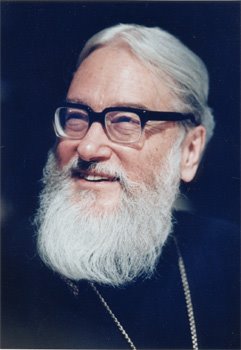
I read a great article this morning on the leadership approach of spiritual fathers and mothers in the Eastern Christian tradition by Bishop Kallistos Ware. It is a great treatment on the central values of humility and love in this approach to Christian Leadership. We need more research and thinking about the value of humility in leadership. Ware writes:

In the Eastern Orthodox tradition at its best, the spiritual father has always sought to avoid any kind of constraint and spiritual violence in his relations with his disciple. If, under the guidance of the Spirit, he speaks and acts with authority, it is with the authority of humble love. The words of Abba Zosima in The Brothers Karamazov express an essential aspect of spiritual fatherhood: "At some ideas you stand perplexed, especially at the sight of men's sin, uncertain whether to combat it by force or by humble love. Always decide, 'I will combat it by humble love.' If you make up your mind about that once and for all, you can conquer the whole world. Loving humility is a terrible force; it is the strongest of all things and there is nothing like it."
Here is a link to Bishop Kallistos' article:

Monday, October 23, 2006

Humility and Christian Scholarship

There is a very helpful article in the Fall edition of Christian Scholar's Review. Written by Roger P. Ebertz, it deals succintly with the problems connected with the "worldview" approach in Christian Scholarship and points the way to a better understanding of the role of Biblical Hermeneutics to shape and frame our role as humble seekers of Truth . Ebertz (2006:28) proposed a humble and open approach in scholarship that seeks to emulate the attitude of Jesus Christ:


"We must stand before the world and before God with the recognition that our perspectives are by necessity incomplete and limited. This humility, in turn, should lead us to be genuinely open to others. In the case of the Christian scholar I believe that this openness faces several directions. The Christian scholar is open to Scripture. She is open toward the subject matter of her field. And she is open to the voices of all of those who, also seek to understand. Although we are not used to applying concepts like 'love' and 'compassion' to the intellectual activity of scholarship, I am inclined to think that they apply. Genuine openness to another is only possible when we care what the other has to say."


Further Reader:
Ebertz, R. P. 2006. Beyond Worldview Analysis: Insights from Hans-Georg Gadamer on Christian Scholarship. Christian Scholar's Review. XXXVI:1

Friday, October 20, 2006

Leadership free from the desire to dominate

I presented a lecture yesterday on the model of Spiritual Direction used by the Desert Fathers and Mothers in the third and fourth centuries of the early Church. I was struck once again by the ethical and moral foundation of leadership presented by these wise Spiritual Fathers and Mothers. The following excerpt from the Philokalia underlines this perspective and approach to leadership:


Amma Theodora said, 'Let us strive to enter by the narrow gate, Just as the trees, if they have not stood before the winter's storms cannot bear fruit, so it is with us; this present age is a storm and it is only through many trials and temptations that we can obtain an inheritance in the kingdom of heaven.' The same Amma said that a teacher ought to be a stranger to the desire for domination, vain-glory, and pride; one should not be able to fool him by flattery, nor blind him by gifts, nor conquer him by the stomach, nor dominate him by anger; but he should be patient, gentle and humble as far as possible; he must be tested and without partisanship, full of concern, and a lover of souls.

Thursday, October 19, 2006

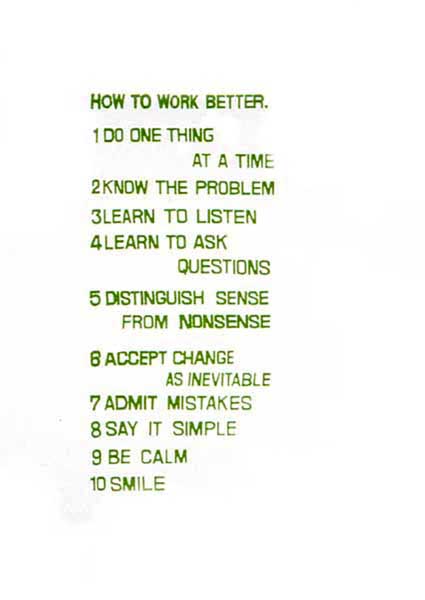
How to work better


Monday, October 16, 2006

Socio-Rhetorical Criticism and the Promise it Holds for Leadership Study

I am leading a workshop tomorrow on the use of new methods of reading Scripture and it's use in leading students in higher education and research. I have been using one of the newer approaches in reading Biblical texts, socio-rhetorical criticism, because of it's high programmatic approach and its socio-cultural focus. Vernon Robbins explains the basic premise of this approach:

"As the twentieth century ends and the third millenium begins, socio-rhetorical interpretation has become a multi-dimensional approach to texts guided by a multi-dimensional hermeneutic. Rather than being another method for interpreting texts, socio-rhetorical interpretation is an interpretive analytical approach that evaluates and reorients its strategies as it engages in multi-faceted dialogue with the texts and other phenomena that come within its purview. The approach does not claim to be comprehensive. Rather, the claim is that the approach uses the insights of sociolinguistics, semiotics and ethnography in an interactionist philosophical mode that sets ancient, modern and post-modern systems of thought in energetic dialogue with one another."

It is my growing conviction that a clearer understanding of the Hebrew and Christian Scriptures holds the promise of a resurgence of moral and values-based approaches to leadership today. Only when our practice of leadership is utterly informed and fueled by the Word of God will we have the kind of Christian leadership that will change the world.


Source:

Robbins, V.R. 1999. Socio-Rhetorical Interpretation from its Beginnings to the Present. Unpublished paper delivered at the South African New Testament Society.

Friday, October 13, 2006

Common Humanity in African Leadership

I am preparing a paper on emerging African approaches to humane leadership as well as finalizing the itinerary for an up-coming trip to South Africa, and thus have been thinking about the promise that a humane approach to leadership (such as the African philosophy of Ubuntu) holds for the re-building of the continent.

Louw (2003) explains the basic premise of ubuntu: “Ubuntu serves as the spiritual foundation of African societies. It is a unifying vision or world view enshrined in the Zulu maxim 'umuntu ngumuntu ngabantu', i.e. ‘a person is a person through other persons’.” The birth of the new democratic nation of South Africa opens the door for a rediscovery of the possibilities of a humane approach to leadership. Maphisa (2004), writing on the eve of the birth of the new democracy says: “South Africans are slowly re-discovering their common humanity. Gone are the days when people were stripped of their dignity (ubuntu) through harsh laws. Gone are the days when people had to use ubulwane [i.e. animal like behaviour] to uphold or reinforce those laws. I suggest that the transformation of an apartheid South Africa into a democracy is a re-discovery of ubuntu”.

There is a similar approach in Paul's letter to the Phillipians (2:2-3) that is rooted in a mimetic devotion of Jesus as the Son of God. He writes: "Let nothing be done through selfish ambition or conceit, but in lowliness of mind let each esteem others better than himself. Let each of you look out not only for his own interests, but also for the interests of others.”

Further Reading:
Louw, D J 2003. Ubuntu: An African Assessment of the Religious Other. Unpublished paper: University of the North.
Maphisa, Sisho. 1994. Man in constant search of Ubuntu: a dramatist's obsession. Pretoria: Ubuntu School of Philosophy.

Thursday, October 12, 2006

The Devotional Discipline of Study

The Biblical, devotional discipline of study has been one on of the "lost" disciplines of recent Evangelical Christianity. There seems to be a hesitancy to think of the mind as an avenue to transformation. Donald Whitney said it best: “Why do we seem to think we must choose between the two? Why do many Christians live as though they've been told, ‘Choose you this day whom you will serve: scholarship or devotion’? I maintain that a Biblically balanced Christian has both a full head and a full heart, radiating both spiritual light and heat.

The wisdom of the ages would suggest that we need to consider study as worship, as an avenue in which God brings transformation to our inner and outer worlds. Karl Barth points us in this direction: “In prayer, theological work is the inner, spiritual and vertically directed motion of man; while I study, although similarly external, it runs in a horizontal direction. It is also an intellectual, and physical, if not fleshly, movement. Theological work can be done only in the indissoluble unity of prayer and study. Prayer without study would be empty. Study without prayer would be blind.”

May we recover a Biblical approach to study that will aid us in the re-discovery of a humble, authentic and transforming approach to leadership.

Wednesday, October 11, 2006

The Evangelical Mind Revisited

I, together with my colleagues at Regent University, am meeting Professor Alan Wolfe, later today, to discuss his opinion article entitled; "The Evangelical Mind Revisited."Alan Wolfe is a professor of political science and director of the Boisi Center for Religion and American Public Life at Boston College.

Professor Wolfe writes:
"One other significant challenge faces evangelical institutions determined to take seriously the life of the mind: they have to make a decision about truth. This ought not to be a problem for them, since serious Christians do not think that their views about God's existence are just matters of opinion. They are convinced that claims of faith are truth claims. Indeed, one of the main gripes conservative Christians have about secularists is their presumed moral relativism, their unwillingness to say flat out that certain things are true (or good or just), and other things are not."

I welcome the oppertunity to enter into discussion with Professor Wolfe and others on these thoughts. I am convinced that a strong, vibrant faith is marked by the willingness to enter into honest, humble and yet rigorous debate about what we perceive to be [T]rue. Truth, if it indeed is true, can hold its own ground.

I am reminded of the words of Caleb Colton (writing of the Biblical devotional discipline of study):
“He that studies only men, will get the body of knowledge without the soul; and he that studies only books, the soul without the body. He that, to what he sees, adds observation, and to what he reads, reflection, is in the right road to knowledge, provided that in scrutinizing the hearts of others, he neglects not his own...”

May our pursuit of understanding reality and He who is "ultimate Real" lead us to the scrutiny of our own hearts and renew our commitment to follow Him, who is the Way, the Truth and the Life (see John 14:6).

Here is a link to Professor Wolfe's article:
http://www.carnegiefoundation.org/change/sub.asp?key=98&subkey=1119

Tuesday, October 10, 2006

New Publication in Christian Spirituality Research

We recently had the joy of hosting Professor Celia Kourie, Professor and author in Christian Spirituality from the University of South Africa and St. Augustine's College. Celia recently co-edited a new publication on research approaches in Christian Spirituality. This publication is the eigth supplemtum to the Acta Theologica Journal. The book is entitled: "The Spirit that moves: Orientation and Issues in Spirituality." (ISBN: 0-86886-713-6). It is worthwhile getting. The research approaches and orientations mentioned in this publication opens many doors for scholars exploring authentic Christian spirituality in leadership.

Kourie writes about the promise that the renewed interest in spirituality brings (2006:35):
" We are witnessing a renewal of interest in perhaps what is one of the oldest traditions in human history, namely, the transmission of spiritual wisdom...It is my contention that the 'turn' to spirituality, both general and academic, will help bring about an ecumenical transformation of consciousness, which will elucidate the many-faceted spendour and diverse ways in which to discover Ultimate Reality."

Source:
De Villiers, P.G.R; Kourie, C.E.T; and Lombaard, C. 2006. The Spirit that moves: Orientation and Issues in Spirituality. Acta Theologica Supplementum 8.

Monday, October 09, 2006

Research Avenues in Spirituality and Leadership

Until recently, there has been a large gap in the literature and research that explore the spirituality of leadership. One exception is the theory of spiritual leadership developed by Fry (2003). One reason for the gap lies in the lack of consensus on the definition and description of the dynamics of spiritual formation as it relates to effective leadership development. A further concern is that the majority of curricula that deal with spirituality and leadership formation are based on non-Christian, or thoroughly secular philosophies and worldviews and as so do not provide much of an avenue for Christians to explore the integration of their faith within a leadership context. It is my conviction that the time has come to address and explore the desperate need for an orthodox, Biblically-based understanding of the nature and dynamics of spiritual formation as it relates to leadership development.

Current research in spirituality, characterized by multi-disciplinary, post-patriarchal, telluric and post-structuralist approaches, locates the phenomena of “spirit” in the ontology of values (see the work of Kees Waaijman for a broader treatment of this). Thus defined, spirituality is seen as the “ultimate” or “inner” values that provide meaning in life. This broad, defining approach provides a platform for scholars to examine a wide variety of spiritualities, ranging from religious to non-religious orientations. Current approaches in spirituality research advocates a “dialogical-phenomenological” research approach making use of the analytical, hermeneutic, mystagogic, form-descriptive, and systematic tools of theology, sociology and psychology.

Contemporary phenomenological investigations in spirituality research, distinguish three basic forms of spirituality (see the ground-breaking work of Kourie and Waaijman in this field): (a) established schools of spirituality, (b) primordial spiritualities, and (c) counter-spirituality. Descriptions of established schools of spirituality describe movements that have its origin in specific historical and socio-cultural settings that over time give rise to discernable schools or ways of the “spirit”. Research of these established schools/ways are marked by investigations of the source-experience, the formation of pedagogical systems, the socio-historical context, the emergence of a values system, the formation of the consistent whole and accessibility of others to the school/way. Primordial spirituality attempts to locate spiritualities that are not closely connected with any school or way, but imbedded in ordinary human experiences such as birth, marriage, having children, experiencing death and suffering. Investigations in primordial spiritualities centers around descriptions of everyday spirituality developed in the context of community, forms of indigenous spiritualities and aspects of secular spirituality. Counter movements in spirituality describes approaches offers alternate solutions to existing social and religious power structures and in research in these fields follows descriptions of systems of liminality, inferiority and marginality.

The surge of interest and development in spirituality research offers new and promising avenues for leadership scholars and practitioners to engage, test and critique the current models and theories of spiritual leadership.

Bibliography:
Fry, L W 2003. Towards a Theory of Spiritual Leadership. Leadership Quaterly, Volume 14, Issue 6, pages 693-727.
Kourie, C 2004. Spirituality: Forms, Foundations. Methods. Journal of Empirical Theology 17 no 2, pages 292-293.
Waaijman, K 2002. Spirituality: Forms, Foundations, Methods. Leuven: Peeters.

Friday, October 06, 2006

Early Church Prayer from Africa

What follows is a simple prayer of dependence on God, written by St. Augustine (354-340 AD), North African Bishop at the turn of the fifth century and a pupil of Ambrose, Bishop of Milan.

Lord, what we know not, teach us.
Lord, what we have not, give us.
Lord, what we are not, make us.

A one-time professor of rhetoric, Augustine was the author of such profoundly influential works as his Confessions and The City of God. He knew devotion, and he knew dissent, learning to rely fully on the Lord only when an older and mature adult. He rooted his leadership approach in complete dependency in God.

Source:
Stewardship Times, October 2006. Volume 3, Issue 10.

Wednesday, October 04, 2006

Yale Conference on Wokplace Chaplaincy

The second National Conference on Workplace Chaplaincy: Models and Making the Case will take place at Yale Divinity School, New Haven, CT, November 9-11, 2006.

This conference is designed for all those involved in using, providing, or considering workplace chaplaincy, including business leaders, HR professionals, academics, and workplace chaplains themselves. Panels and forums will be offered on various issues, including how to develop and utilize workplace chaplaincy, how to offer an effective ministry to multi-cultural/ multi-faith workforces, and how workplace chaplains can better network to share ideas and training.

Here is a link to their website: http://www.yale.edu/faith/esw/ncwc.htm#

Shining like the Sun

I spent a few days with the Evangelical Covenant Church in Fairmont, Minnesota this last week, speaking and participating in their celebrations of the dedication of their new facilities. I was deeply touched by the simple faith and deep love of the ministers and people of this small town congregation. I kept on thinking about the experience Thomas Merton had in a Louisville, Kentucky. He writes of this, in his book, Conjectures of a Guilty Bystander:

"In Louisville, on a corner of Fourth and Walnut, in the center of a shopping district, I was suddenly overwhelmed with the realiztion that I loved all these people, that they were mine and I was theirs, that we could not be alien to one another even though were total strangers...I have the immense joy of being human, a member of a race in which God Himself became incarnate. And if the sorrows and stupidies of the human condition could overwhelm me, now that I realize that we all are. If only everybody could realize this! But is cannot be explained. There is no way of telling people that they are all walking around shining like the Sun!"

I felt like this, all the time I spent with this beautiful congregation.

Further Reading:
Merton, T (1996). Conjectures of a Gulity Bystander. New York: Doubleday.