Thursday, August 31, 2006

GLE Organizational Values

I am teaching a course in Organizational Ethics and Values this semester in the Doctor of Strategic Leadership Degree here at Regent University. I have been reflecting today on our own organizational values in the newly formed School of Global Leadership and Entrepreneurship (GLE) and how this intersects/reflects with the values of Biblical Christianity. The Dean of our school, Dr. Bruce Winston asked me and others to help in framing our values. We came up with the following:

In the School of Global Leadership and Entrepreneurship (GLE), we value:

  • Devotion. We worship God, our Creator, through Jesus Christ, and are empowered by the Holy Spirit to offer our work and interaction with everyone as our reasonable service to Him through the biblical values of love, service, mutuality, humility and obedience.

  • Excellence. We strive to be professionals of excellence in the quality of our work as we offer innovative solutions and insight to our organizations and entrepreneurial enterprises.
  • Innovation. We embrace the new and test the old in order to find the best for both today and tomorrow as we seek to develop new and creative tools and methods to achieve our mission. We are committed to examining how we do what we do, why we do it and what we should be doing.
  • Efficiency. We choose to be servants to those whom we encounter, providing consistent, efficient and accurate assistance. This requires that we be stewards of resources and seek the greater good of the greater whole.
  • Integrity. We strive to always exhibit Christ-like character in our actions, words and deeds. We seek to be who we say we are and to have our deeds measured against our words as we "walk our talk."
  • Respect. We are a family of brothers and sisters in Christ as we demonstrate healthy respect for, and build eternal relationships with, one another. This requires that we embrace diversity of faith traditions, cultures and history as we operate in unity toward the fulfillment of the greater mission.
  • Peace. We strive to be ambassadors of peace in the midst of diverse beliefs and interpretations of faith and love as we stand firm in our convictions and provide insight and encouragement, so we may edify and refine one another in the pursuit of truth and the advancement of the mission.

Tuesday, August 29, 2006

Leadership free from confusion

I have been wondering if it is possible to seek God in a position of leadership, when most of the contemporary pursuit of leadership is burdened by desperate illusions and inordinate desires for power, prestige and status. The example and message of Jesus and his early followers propose that is very possible to see leadership as a determined relinquishment of our carnal desire for fame and fortune, and to use the call to lead as an oppertunity to emulate Christ, who desired to be made of "no reputation" (Philippians 2:7). I have been rereading Merton for the last few weeks in my devotional time and came upon this section, earlier this morning:

“This then is what it means to seek God perfectly: to withdraw from illusion and pleasure, from worldly anxieties and desires, from the works that God does not want, from a glory that is only human display; to keep my mind free from confusion in order that my liberty may be always at the disposal of His will; to entertain silence in my heart and listen for the voice of God; to cultivate an intellectual freedom from the images of created things in order to receive the secret contact of God in obscure love; to love all men as myself...”

This, for me, is an erudite description of the process of value/s formation in Christian leadership.

From New Seeds of Contemplation by Thomas Merton. New Directions Publishing Corporation, 1972. Pages 45-46.

Monday, August 28, 2006

Paper on Mimetic Christological Model of Leadership available

The paper I read at this year's Servant Leadership Research Roundtable entitled, "The Philippians Hymn (2:5-11) as an early mimetic Christological model of Christian Leadership in Roman Philippi", is now available at: www.regent.edu/acad/sls/ under publications and proceedings.

The abstract reads as follows:

This paper proposes an early mimetic Christological model of Christian Leadership in Roman Philippi by exploring the judicial, rhetorical structure and the social function of the Philippians hymn (2:5-11) as a cursus pudorum (course of ignominies) that stands in contrast to a cursus honorum, the formalized sequence of public offices in first-century Roman cities. The Philippians hymn challenged the notions and principles of the prevalent shame/honor social matrix of Roman societies by offering an alternative set of behaviors and values that stood in stark contrast with those of the dominant culture. The hymn makes use of a cursus pudorum in which the voluntary abasement, humility and obedience of Christ becomes an exemplum that offers a critique of the tyrannies of the timocratic leadership style of Roman Philippi and offers an alternative vision of service oriented leadership rooted in humility and mutuality.

Tuesday, August 22, 2006

Merton's Insights on the False Self

I have been rereading James Finley’s monumental book on Merton’s theology of spiritual identity, this week: “Merton’s Palace of Nowhere”. The section dealing with the False Self continues to shape my thinking and writing on authentic Christian identity and in turn our quest for true Christian leadership, free from selfish ambition and inordinate competitiveness.

Here follows three of Finley’s probing insights on Merton’s understanding of the false self:
  • The False Self is a whole syndrome of lies and illusions that spring from a radical rejection of God in Whom alone we find our own truth and ultimate identity.
  • Merton equates sin with the identity-giving structures of the False Self – thus the focus of sin is shifted from the realm of morality to that of ontology.
  • Sin, and therefore the False Self, is a fundamental stance of wanting to be what we are not. Sin is thus an orientation to falsity, a basic lie concerning our own deepest reality.

For Merton, our deep and truest identity is found in our rediscovery of God through the revelation of His Son, Jesus of Nazareth:

“The secret of my identity is hidden in the love and mercy of God….Ultimately the only way that I can be myself is to become identified with Him in whom is hidden the reason and fulfillment of my existence. Therefore, there is only one problem on which all my existence, my peace and my happiness depend: to discover myself in discovering God. If I find Him I will find myself and if I find my true self I will find Him.”

Finley, J. 2003. Merton’s Palace of Nowhere. Notre Dame: Ave Maria Press.
Merton, T. 1961. New Seeds of Contemplation. New York: New Directions.

Monday, August 21, 2006

Building with/out God

I was deeply struct by a reading from Thomas Merton this morning. Merton in his usual erudite manner show the danger of thinking that leadership is primarily about power and dominance:

“Those who seek to build a better world without God are those who, trusting in money, power, technology and organization, deride the spiritual strength of faith and love and fix all their hopes on a huge monolithic society, having a monopoly over all power, all production, and even over the minds of its members. But to alienate the spirit of man by subjecting him to such monstrous indignity is to make injustice and violence inevitable. By such means we may indeed increase economic production but in doing so we will onlymake the world worse.”

I could not help but to think of the words of Psalm 127 (verse 1): "Unless the LORD builds the house, its builders labor in vain. Unless the LORD watches over the city, the watchmen stand guard in vain. "

May our quest for moral leadership be focused on the "power" of love and faith, rooted in our desire to imitate He who is all truth.

From Disputed Questions by Thomas Merton (San Diego: Harcourt Brace Jovanovich, Publishers, Inc. 1960), page 129.

Wednesday, August 09, 2006

Spiritual Formation and Leader/Follower Development


The quest for Spiritual Formation falls in the academic field of spirituality. The Oxford Dictionary defines “spirituality” as the quality or condition of being spiritual. In turn it defines “spiritual” as devout, holy, pious, morally good. Kenneth Leech defined Christian Spirituality in the 1980's as being about a process of formation. We are thus formed by, and in, Christ. For Leech – it (Spiritual Formation) is a form of Christ-[ening] – being clothed with Christ, and so being transformed into the same image. This simple description seems to conform Paul’s understanding of this in Romans (8:29) when he links destiny, vocation and spiritual formation:
“And we know that all things work together for good to those who love God, to those who are the called according to His purpose. For whom He foreknew, He also predestined to be conformed to the image of His Son, that they might be the firstborn among many brethren.”
In simple language to be formed as a Christian – in this instance, formed as a leader – is to be formed into the image of Jesus. It is interesting to note that Paul consistently makes use of the Greek word “icon” to the describe the image we are suppose to be transformed into – thus this image is not an end in itself – but rather a window of a larger reality. Thus we become an image/window of a larger reality – in this case, an image of Christ – not a representation but rather a window.

The major question would then be how this happens – the process of formation. A preliminary reading of the Pauline writings suggests that there might be a very clear model of spiritual/leadership formation in his thoughts/theology. In Paul’s second letter to the Corinthians (3:18):
“And we all (literally in the Greek – in the midst of us all – or, all of us together), with unveiled faces, beholding the glory of the Lord as within a mirror are being transformed into the same image from glory to glory, just as by the Spirit of the Lord.”

Three elements/steps seem to emerge from an inner texture analysis of this text that might be useful to describe a Pauline understanding of spiritual/leadership formation:
  • Accept our environment (…and we all…) – this might describe the value/act of giving consent to where God puts us – a sensitivity to our context – Situational Leadership. This might further refer to accept the calling/vocation that our situations bring to us.
  • Have voluntary honesty (…with unveiled face…) – a socio-cultural reading of this links Paul’s use of this reference with both Old Testament thoughts as well as the Greek use of masks in their comedy and tragic plays. This might describe the values/acts of integrity/authentic approaches in leadership.
  • Have a determined (devotional) focus on our deepest inner truth (…beholding as within a mirror the glory of the Lord…) – this might refer to the willingness to be gathered and formed by our inherent “spiritual” truths within us – in a Christian sense to surrender to the Truth of the Spirit within us. In a nutshell the willingness to be formed by the image/ethos/attitude of Christ.

It seems to me that when these three elements work together that Christian spiritual and leadership formation takes place within the follower/leader.

Monday, August 07, 2006

Poverty of Spirit

Dr. Bruce Winston, the Dean of our school (School of Global Leadership and Entrepreneurship) here at Regent University, proposes that the first beatitude in Matthew's Sermon on the Mount (5:3); "blessed are the poor in spirit, for theirs is the kingdom of heaven", is the foundational and primary value for Christian Leadership. Judith Hougan proposes that poverty is central to our experience as humans: "...poverty is part of our story, our reality, part of who we are in this fallen world. This poverty is not specifically our sin nature, but in our weakness, we certainly fall prey to sin." Hougan continues on and describes how the "myth of competence" hinders our acceptance of our "poverty of spirit" and thus keeps us from accepting and receiving the kingdom of heaven: "The myth of competence is founded in a competitive framework for living, the idea that life is about 'bigger and better'."

When leaders accept our own poverty of spirit, we are free to be honest and true - free to speak about our brokenness, sin and wrong motives within the larger community and thus we are ushered into the arena of the possibility of growth and Gospel transformation that the kingdom of heaven offers. Dietrich Bonhoeffer comments: "He who is alone in his sin is utterly alone....The final breakthrough to fellowship does not occur, because, though they have fellowship with one another as believers and as devout people, they do not have fellowship as the undevout, as sinners. The pious fellowship permits no one to be a sinner. So everyone must conceal his sin from himself and from the fellowship. We dare not be sinners."

Christian leaders take the first step in leading, by accepting their own personal brokenness and poverty and so come to the end of themselves - ready to accept that Christ shall be all and that He is the only hope for moral and transformative leadership.

References:
Bonhoeffer, D. 1954. Life Together. New York: HarperSanFrancisco, page 110.
Hougen, J. 2005. The Community of the Broken. Conversations, Volume 3:2, 55-60.

Thursday, August 03, 2006

Pride as Madness

Baruch Spinoza, a 17th century Jewish/Dutch philosopher (1632-1677 CE) described pride as a form of madness: "Thus we see that it may readily happen, that a man may easily think too highly of himself, or a loved object, and, contrariwise, too meanly of a hated object. This feeling is called 'pride,' in reference to the man who thinks too highly of himself, and it is a species of madness." C. S. Lewis described pride as the "complete anti-God state of mind...the great sin."

The problem of pride in leadership is that it provides leaders with a completely false sense of themselves. They find their identity in their talents, expertise, accomplishments and possessions. The only cure for this kind of prevalent leadership madness is a clearer vision of God in which we find our own true self, created and sustained in Him. John Calvin made this connection, "...it is certain that man never achieves a clear knowledge of himself unless he has first looked upon God's face...For, because all of us are inclined by nature to hypocrisy, a kind of empty image...". I am persuaded that authentic Christian leadership starts withthe quest for a clearer vision of God in which the false images of pride are stripped away to provide, in the words of John Michael Talbot, "an empty canvas" ready to bear the image of our Lord.

Wednesday, August 02, 2006

Leadership as Spiritual Practice

Anthony Robinson (2005) defines leadership as a spiritual practice that in the words of Dorothy Bass is part of "those shared activities that address fundamental human needs and that, woven together, form a way of life." I have been challenged recently by one of my mentors as we shared a meal, Eric Watt (our local pastor and one of the humblest and accessible men I have ever met) to think of Jesus as my friend that desires to spend time with me and share in my life. This challenge has led to several new avenues of personal exploration on the nature of leadership as a shared activity: shared with God and the people we serve.

Robinson (2005, 28), influenced by this idea of leadership as a shared spiritual activity/practice, writes about the misconceptions about leadership, vision and expertise:

"True leadership does not simply influence the community to follow the leader's vision, but also enables the community to face its most critical challenge and to be what God calls and enables it to be. There is too much stress today on the leader as the person of vision. A vision is not imported from somewhere else, and it is not the idiosyncratic vision of one charismatic woman or man. A vision arises from a careful reading of the context and the work required by God of a particular people with a particular identity....Leadership is not the same as expertise, although the two are often confused. Experts come equipped with a variety of technical fixes, new tools. These are fine as far as they go, but they don't engage people in loss, risk and trust. In fact, people may try to avoid the challenge of the more difficult work of preoccupying themselves with the latest tools and techniques. Experts do things for us; leaders go with us."

Robinson, A. B. 2005. Give and Take: Leadership as a Spiritual Practice. Christian Century 122.20, No. 20: 28-32.

Monday, July 31, 2006

Church Service with Ph.D. Leadership Students at the oldest standing Church Building in the USA

I will be leading a church service with our second and third year Ph.D. students during their upcoming doctoral residency at Venerable Historic St. Luke's, Mother Church of Warrosquyoake County (now called the Isle of Wight), this Sunday, August 6. This church building might be the oldest standing structure of Christian faith in the United States of America and dates back to 1632. This is picture of the beautiful windows of the church. One cannot help but be deeply humbled by the deep witness of this structure of faith through the ages and hope that our commitment to authentic Christian Leadership may also stand the test of the ages.

For more information see: http://www.historicstlukes.org/index.html

Saturday, July 29, 2006

The Philippians Hymn (2:5-11) as an early mimetic Christological model of Christian Leadership


I will be presenting a paper this next week on the Philippians Hymn (2:5-11) as an early mimetic Christological model of Christian Leadership at the annual Servant Leadership Research Roundtable in Virginia Beach. A draft version of the introduction of the paper reads as follows:

The myriad scholarly discussions on the Christological hymn (compare the excellent overview of the research in Martin 1997) in the letter of Paul to the Philippians (2:5-11) have traditionally been occupied with the issues of ontological Christology (Hellerman 2003, 424), questions on authorship (Martin 1997, 42-62) and literary form and function (Black, 1995) with little or no agreement amongst scholars on these issues (Stagg 1980, 340). Recent studies have attempted to escape the inertia created in these studies by exploring the hymn as an ethical rhetorical device and paradigm (Fowl 1990, Geoffrion 1993), as mediating tool in the midst of communal disunity and strife (Peterlin 1995, Williams 2002), as social drama (Karris, 1996, Wortham 1996), and as resistance against local timocratic rule (Heen 2004, Hellerman 2003, and Oakes 2001). What these recent developments have in common is a determined effort to place the hymn within the social and cultural context of first-century Philippi and the consensus that the hymn is a religious response to the tyranny of local Roman ruler and leadership. This opens the door for scholars to explore the hymn as an exemplary model (a rhetorical exampla) of ethical leadership rooted in a mimetic Christological spirituality. This paper proposes an early mimetic Christological model of Christian Leadership in Philippi by exploring the judicial, rhetorical structure and the social function of the hymn as a cursus pudorum (course of ignominies).

Bibliography (of the draft version of the introduction):
Black, D. A. 1995. The Discourse Structure of Philippians: A Study in Text-linguistics. Novum Testamentum XXXVII, 1: 16-49.
Fowl, S. E. 1990. The Story of Christ in the Ethics of Paul: An analysis of the Function of the Hymnic Material in the Pauline Corpus. Sheffield: Sheffield Academic Press.
Geoffrion, T. C. 1993. The Rhetorical Purpose and the Political and Military Character of Philippians. Lewiston: Mellen Biblical Press.
Heen, E. M. 2004. Phil 2:6-11 and Resistance to local Timocratic Rule: Isa Theo and the Cult of the Emperor in the East, in Horsely, R. A. Paul and the Roman Imperial Order. New York: Trinity Press International.
Hellerman, J. H. 2003. The Humiliation of Christ in the Social World of Roman Philippi, Part 1. Bibliotheca Sacra 160.639:321-336.
Hellerman, J. H. 2003. The Humiliation of Christ in the Social World of Roman Philippi, Part 1. Bibliotheca Sacra 160.640:421-433.
Karris, R. J. 1996. A Symphony of New Testament Hymns. Collegeville: The Liturgical Press.
Martin, R. P. 1997. A Hymn of Christ: Philippians 2:5-11 in Recent Interpretation and in the setting of Early Christian Worship. Downers Grove: Intervarsity Press.
Oakes, P. 2001. Philippians: From People to Letter. Cambridge: Cambridge University Press.
Peterlin, D. 1995. Paul’s Letter to the Philippians in the Light of Disunity in the Church. Leiden: E. J. Brill.
Stagg, F. 1980. The Mind of Christ Jesus: Philippians 1:27-2:18. Review and Expositor 77.3:337.
Williams, D. K. 2002. Enemies of the Cross of Christ: The Terminology of the Cross and Conflict in Philippians. London: Sheffield Academic Press.
Wortham, R. A. 1996. Christology a Community Identity in the Philippians Hymn: The Philippians Hymn as Social Drama (Philippians 2:5-11). Perspectives in Religious Studies 23:3: 269- 287.


For more information see: http://www.regent.edu/acad/sls/conferences/roundtable/home.htm

Tuesday, July 25, 2006

4th Annual Foresight Conference for Christian Leaders


My friend, Jay Gary is hosting Foresight 2006: Leading from the Future in Virginia Beach, September 20-22. Foresight 2006 is the fourth annual foresight conference for Christian leaders, and this year's theme of leading from the future, not just the past, is focused on the genetics age and the challenges facing organizations, churches, ministries and schools.

Jay described the conference as follows:

Imagine spending three days conversing over lunch and in small groups with leading strategists from faith-based, academic and business contexts from all across the country. You'll spend time with Dr. Ted Peters, America's leading theologian on science and religion, bio-ethics and futures thinking.

In workshops such as "Developing and using scenarios in public and private sectors," you'll learn the art of strategic thinking from national consultants like Dr. Clem Bezold, chairman of the Institute for Alternative Futures and board member of the World Future Society.

You'll also hear Tom Hoffmann, pastor and missional leader, speak on driving forces shaping global Christianity. You will grapple with what it means to be part of a church that is shifting its center of gravity to the south. Also, Mary Beth McEuen, VP of People and Potential at Maritz, will speak on cultivating strategic leadership with forward views.

Foresight 2006 is for anyone interested in the future of leadership and transformational change. Whether you are a manager, consultant, ministry leader, educator, pastor, health-care worker, military leader or teacher, this conference is for you.

For more information see: http://www.regent.edu/acad/sls/conferences/foresight/

International Conference on Integrating Spirituality and Organizational Leadership

Regent University's School of Global Leadership and Entrepreneurship and the University of Delhi's Faculty of Management Studies have issued a call for papers for their International Conference on Integrating Spirituality and Organizational Leadership (ICISOL) to be held in Delhi, India, February 8-10, 2007.

Conducted in the English language, the ICISOL will bring together leading scholars from the USA, Europe and Asia to systematically explore and map the field of spirituality and organizational leadership from various disciplines and spiritual traditions to focus on the role of spirituality and leadership in renewing the contemporary management praxis.

Designed for academicians, business leaders and those representing business associations, civil society and the media, this conference will address:

  • Changing business paradigms to meet the ecological and social realities of our age
  • The change from work and worship to “work is worship”
  • The role of spirituality in transforming contemporary management theory and praxis
  • Integrating perception of self and identity into managerial context
  • Contributions from different religious traditions and their value perspectives for the renewal of corporations and their cultures
  • Transcendental approaches for optimal performance
  • Implications of transpersonal experience and non-ordinary states of consciousness for ethics in general and for business ethics in particular
  • Promoting a spirit–centered leadership style for generating happiness in the workplace for optimal performance

For more information see: http://fms.edu/conference/IntConf/rtc.htm

Sunday, July 16, 2006

Seminar on Hermeneutics and Leadership at Heritage Bible College

I will be presenting a seminar on Hermeneutics and Christian Leadership at Heritage Bible College in Dunn, North Carolina tomorrow, July 17. As I prepare for this I cannot help but to once again think of the importance of proper exegesis and the use of Scripture to explore Leadership. I wonder why so many leadership scholars are reluctant to look at the Hebrew and Christian Scriptures as valid sources in our exploration of moral leadership. I am reminded of a wonderful rabbinical story that Knut Grønvik relays that might explain this scholarly hesitance:

Rabbi Eliezer was the first to speak. “If a man really wants to understand a word in scriptures,” he said, “he has to enter into it with his whole being.” “But is it not impossible for a grown-up man to enter into a small word?” one of his disciples objected. “I did not speak about men who think they are bigger than words,” the Rabbi answered.

May we all be humbled by the (T)ruth of God's eternal Word.

Grønvik Knut. "Letting Scripture read you." Conversations 3:1 (Spring 2005).

Merton, Sin and Organizational Sickness

I am busy writing the first of series of articles on the nature and remedy of organizational sin. I hope to use the nine prime sins of the Greek Desert Fathers and Mothers as a foundation for my exploration. One of the most peculiar practices amongst Christian leaders is the pervasive habit of discrediting another brother, minister of family in order to somehow establish personal or even organizational credibility. Thomas Merton, the American trappist and hermit, reflects on this:

"It has been marked that the more totalitarian a society is, for example, that of Russia or of Hitler's Germany, the less its members feel any sense of sin. They can commit any evil without remorse as long as they feel they are acting as members of their collectivity. The only evil they fear is to be cut off from the community that takes their sin upon itself and 'destroys' them. This the worst of disasters, and the slighest indication of disunion with the group is the cause of anxiety and guilt."

When we loose the "sense of sin", we loose the possibility of sanctification. May we learn the wisdom of Jesus that calls for a open heart and a non-judgmental attitude towards others (Matthew 7:1). May we follow in the footsteps of the Apostles and do nothing out of selfish ambition or conceit, but in lowliness of mind esteem others as better than ourselves (compare Philippians 2:1-2).


Merton, T 2003. The Inner Experience. New York: HarperColins. Page 120.

Tuesday, July 11, 2006

Spirituality, Systems Thinking and Healthy Relationships


I spend the last week at Forest Home Ministries in California where I was the evening speaker for one of their family camps. I spend the week exploring the Divine invitation of Jesus to find our way, home, purpose and joy in Him (compare John 14:6 and 15:1-11).

I had the privilege during this week to spend time with Dr. Mark Brewer, Senior Pastor of Bel Air Presbyterian Church, who presented in the mornings. Mark is a marvelously gifted speaker and presented some great insights from systems thinking and his experience in ministering to people in the entertainment industry.

Mark presented five principles of healthy relationships that I think hold great promise for future research and thinking in leadership and spirituality:

  • Relational systems resist change (the principle of homeostasis), even if the change brings about a better system.
  • The neediest person in a system is often not the sickest one (the principle of the identified patient). Energy should be spend on the most responsive person in the system, not the apparent neediest one.
  • The power of one's presence holds great promise (the principle of differentiation). Leaders should be present to their followers by defining who they are and not become part of the problem.
  • When two people are experiencing problems they will include a third person, system or issue into the equation (the principle of triangling).
  • Relational system are more complex than what they seem (the principle of the extended family). People operate in several connected system at a time.

Mark has a great book out entitled: "A Walk in the City: Discovering the Principles of the New Relationships between Urban and Suburban Churches." (ISBN: 0-9704619-0-9) that makes a much needed contribution to our understanding of relational leadership in pursuing Church unity.

Wednesday, June 21, 2006

Contemplation of death and the quest for Christian leadership

One of our colleagues, a Godly and accomplished woman by the name of Betty Davis, went home to be with our Lord unexpectedly yesterday. This kind of close encounter with death in an organizational context made me think again today of the fragility of life and our common call to authentic Christian leadership.

Christian thinkers going back to St. Paul have described Christian leadership as an engagement with the eternal struggle between two opposing spiritual forces. St. Augustine of Hippo spoke of the City of God and the City of the World: the Civitas Dei and the Civitas Mundi. The former is dedicated to serving others and to God's will and to His glory. The latter is dedicated to the pursuit of worldly ideals - communities, cities of selflishness.

It is clear that St. Augustine was right; and that the contemporary western intellectual world, like the world of his times, is a battleground in which rages a battle for the souls of this world.

Today there is a challenge before us: Christian leadership to change the world. How do we do this? How do we ensure that we do not follow the road of worldliness (the road that leads to the Civitas Mundi, in St. Augustine's words) taken by so many others that have came before us? How do balance the call to holiness and leadership?

St. Francis of Assisi, in the thirteenth century, writing in a letter to the leaders of his day proposes a surprising approach to this tension in leadership:
"Pause and reflect, for the day of death is approaching. I beg you, therefore, with all possible respect, not to forget the Lord or turn from His commandments by reason of the cares and pre-occupations of this world...you should manifest such honor to the Lord among the people entrusted to you...that praise and thanks may be given by all people to the all powerful Lord God."
I would like to highlight the central thought of St. Francis here: contemplating our own mortality as a way to understand and to surrender to our vocation to service, witness, holiness and transformation, because we have a sacred duty to those entrusted to us.

This idea is not new to scripture. Moses writing in Psalm 90 says: "Teach us to number our days, that we may gain a heart of wisdom." Contemplating death has a way of focussing us and distilling our vision of God and reality. This does not mean that we must exclusively focus on death or adopt a morbid spirituality. On the contrary, the Swedish Leader Dag Hammarskjöld once said:
"Do not seek death. Death will find you. But seek the road which makes death a fulfillment."
We do not walk blindly. Albert Schweitzer once reminded all that: "Example is Leadership."

The quest for Christian leaders is to follow and lead as Christ did, so that we all one day can stand before our Maker and declare: "It is finished." We have done what was asked of us.

Saturday, June 17, 2006

Seminar on Christian Leadership at Project Bridges in DC

I will be leading a one-day seminar on the call and process of Christian Leadership at Project Bridges in Washington DC on Saturday, June 24. I have entitled the seminar, "Following in the footsteps of Jesus: The Call and Process of Christian Leadership." Project Bridges' mission is to strengthen and expand the capacity of churches and community organizations through strategic alliances and partnerships that provide relevant training, services, programs and resources. For more information on Project Bridges, follow the link to their website:
http://www.projectbridges.org/welcome.html

The following is a synopsis of the seminar:
The call of Christian leadership brings a deep challenge to those who desire to emulate the leadership of Jesus Christ. Christian leadership requires the voluntary relinquishment of temporal power by those called to lead. The theological construct of the kenosis (self-emptying) of Christ as mentioned in the Philippians Hymn (2:5-11) provides Christian leaders with a foundation for the understanding and application of true biblical leadership formation. This seminar will provide you with a biblical foundation for true Christian leadership and explore practical steps on how leaders are called, shaped, empowered and sent as community leaders that in turn will change their world.

Friday, June 16, 2006

Journal of Biblical Perspectives in Leadership (JBPL)

I am excited to announce that our school has launched a new on-line journal that seeks to explore the Biblical base for Christian leadership. This journal will be known as the Journal of Biblical Perspectives in Leadership or JBPL for short. I have been asked to be the editor of this new journal and look forward with great anticipation to the opportunity to learn and grow together with so many other scholars and practitioners that seek to facilitate the unfolding of God's Word in our world. The following is a short excerpt from the up-coming news release on the journal as well as links to the journal's homepage (click on the underlined title of the journal below):

The Journal of Biblical Perspectives in Leadership (JBPL), Regent University's newest online publication, seeks manuscript submissions for possible publication in its inaugural issue scheduled for a late Fall 2006 release. All submissions should meet JBPL submission guidelines and be received by JBPL at jbpl@regent.edu no later than August 15, 2006.

Sponsored by Regent University's new School of Global Leadership and Entrepreneurship (GLE) and led by GLE Associate Professor Dr. Corné Bekker, the JBPL is a refereed scholarly journal that aims to provide a forum for international research and exploration of leadership studies focused on the Hebrew and Christian scriptures.

Please feel free to forward the link to the journal to anyone you know who shares in this passion for the re-discovery of the Biblical (T)ruths of scripture in our pursuit of Christian leadership.

Reflections on Kenotic Leadership at Leadership Talks

A short audio recording I did a while back on exploring Kenotic aspects of Christian leadership is featured this month at Leadership Talks:
http://www.regent.edu/acad/sls/leadershiptalks/archives.htm

Leadership Talks is a free monthly audio e-newsletter that provides fresh insights and perspectives from leadership scholars, practitioners and presenters from around the world.

Studying the Leadership of Sts. Paul, Francis and Clare of Assisi in Italy 2007


I will be joining Dr. Karin Klenke in 2007 in Italy to lead a studies abroad trip to explore the leadership of the Apostle Paul and Sts. Francis and Clare of Assisi. The itinerary, scope and costs will be available in time at the following link: http://www.regent.edu/acad/sls/study_abroad/2007/home.htm

St. Clare of Assisi holds a special research interest for me and I presented a paper on her Kenotic Mysticism and Servant Leadership at the Servant Leadership Roundtable in August 2005.

The abstract for this paper, entitled "Kenotic Mysticism and Servant Leadership in the letters of Clare of Assisi to Agnes of Prague", follows:
This paper explores the spirituality and leadership of Clare of Assisi in the letters to Agnes of Prague. Successive repetitive-progressive pattern analysis of the letters to Agnes of Prague places Clare within the domain of servant leader and identifies her leadership values as congruent to Kathleen Patterson's theoretical model of servant leadership. Clare's spirituality is one of appropriation of the kenosis of Jesus Christ. Clare of Assisi links her kenotic mysticism with her practice of servant leadership in an inter-dependent dynamic system of personal and communal transformation through radical self-emptying.

Feel free to contact me if you want a copy or link to the paper.

Thursday, June 15, 2006

Empty to Lead: In Search of Kenotic Leadership


Another proposal we did for a panel presentation on the exploration of an authentic model of Spiritual Leadership at the International Leadership Association's (ILA) Annual Conference in Chicago (November 2-5), has been accepted:
http://www.academy.umd.edu/ILA/Conferences/index.htm

I will be presenting a paper entitled, "Empty to Lead: In Search of Kenotic Leadership." Here is the preliminary abstract for the presentation:

The Christian theological construct of kenosis is developed from the occurrence of the Greek word kenao in the Christological Hymn of Paul’s letter to the Philippians (2:5-11) where it describes the voluntary self-emptying of Christ in the incarnation. New Testament scholars have argued in the last century that the grammar, style and vocabulary of the hymn indicate that it was a Greek composition, that the author was most likely a Semitic language speaker, that it was part of the Eucharistic liturgy of the Christian community in Jerusalem and thus probably pre-Pauline. The Christological hymn thus, contains some of the earliest doctrinal and ethical statements of the early Christian movement.

Kenosis, as an ethical construct of the Christian doctrine of the incarnation, speaks of a very specific belief in the mode of God’s interaction with the world. In the doctrine of incarnation, the Christian claim is that God actually lived the life of a man in Jesus of Nazareth and thus the kenosis of God in Christ provides an ethical and philosophical mode of leadership that is based on voluntary abasement and mutuality with all of humankind.

Appropriating the values of kenosis in leadership requires the identification and acceptance of the social and cultural locality of the “self” and the “other” as the beginning point in the leadership exchange. The values of kenosis have been described as, (a) voluntary self-limitation, (b) vulnerability, (c) present to the “other”, (d) voluntary powerlessness, (e) continual purification from self-centeredness, (f) humility, (g) self-sacrifice, and (h) openness to the “other”. Kenosis addresses the true challenge of dialogical behavior and when appropriated is often rooted in a mimetic re-enactment of the self-emptying (kenotic) Christ.

Appropriating the values of kenosis lead to personal transformation of both the leader and follower and enables them to find each other in renewed relationship of radical divesting of power. This “resolute divesting” of the prestige and power inherent in the leadership transaction enables the leader and follower to enter into a new union that is marked by equality and service.

Ubuntu and Mutuality in Post-Apartheid South African Leadership

I recently received word that our proposal on African Leadership has been accepted for the International Leadership Association's (ILA) Annual Conference in Chicago (November 2-5, 2006.) :
http://www.academy.umd.edu/ILA/Conferences/index.htm

I will be presenting a paper entitled: "Ubuntu and Mutuality in Post-Apartheid South African Leadership." Here is a short introduction to the main premise of the paper:

Recent studies in Southern Africa have highlighted the desperate need for indigenous, innovative, values-based leadership approaches in South Africa that will mobilize a wide variety of participants around the common goal of reconstructing a society ravished by racial discrimination, disease prevalence, economic injustices, corruption, crime and leadership failure. This new, emerging, post-industrial paradigm of leadership has helped South Africans to start to think of leadership as something that is done in community in stead of the acts of one privileged individual. This paradigm shift from extreme individualism to perspectives in communal leadership is a global phenomenon and is contrasted with the individualistic, competitive leadership approaches of the Apartheid Regime. This shift to values-based leadership approached is mostly marked by communal presence, trust, dialogue and mutuality.

The South African Nguni word ubuntu, from the aphorism; “Umuntu Ngumuntu Ngabantu – A person is a person because/through others”; can be described as the capacity in African culture to express compassion, reciprocity, dignity, humanity and mutuality in the interest of building and maintaining communities with justice and mutual caring. More than a descriptor of African values, ubuntu should be seen as a social philosophy that is deeply embedded in African culture and the primary foundation of an African worldview.

Ubuntu, seen in the spirit of participatory humanism, has the power to effect a revitalized commitment in South Africans to the rebuilding of their communities. The value and practice of mutuality in ubuntu is defined paradoxically by the differences found in the “other”. Accommodation and respect for the differences in the “other” flows from a recognition of the common humanity of the “self” and the “other”. Mutuality in ubuntu allows for the breaking down of the superficial and artificial barriers between the “actors” in the leadership exchange and allows both leader and follower to see the “other”, discover their mutual humanity and in doing so foster the construction of a caring community that allows for the respectful tolerance of social, cultural, economic and philosophical differences.

The aim of this presentation is to explore the value of mutuality in the African, social philosophy of ubuntu within the matrix of emerging values-based leadership approaches. The cultural and social concepts of ubuntu are rich in definition and implication, and in the light of the constraints of this brief study, the focus is firmly placed on the common value of mutuality and so provide a conceptual platform so as to consider what this might mean for contemporary, Post-Apartheid, South African leadership.

First International Conference on Values-based Leadership in South Africa


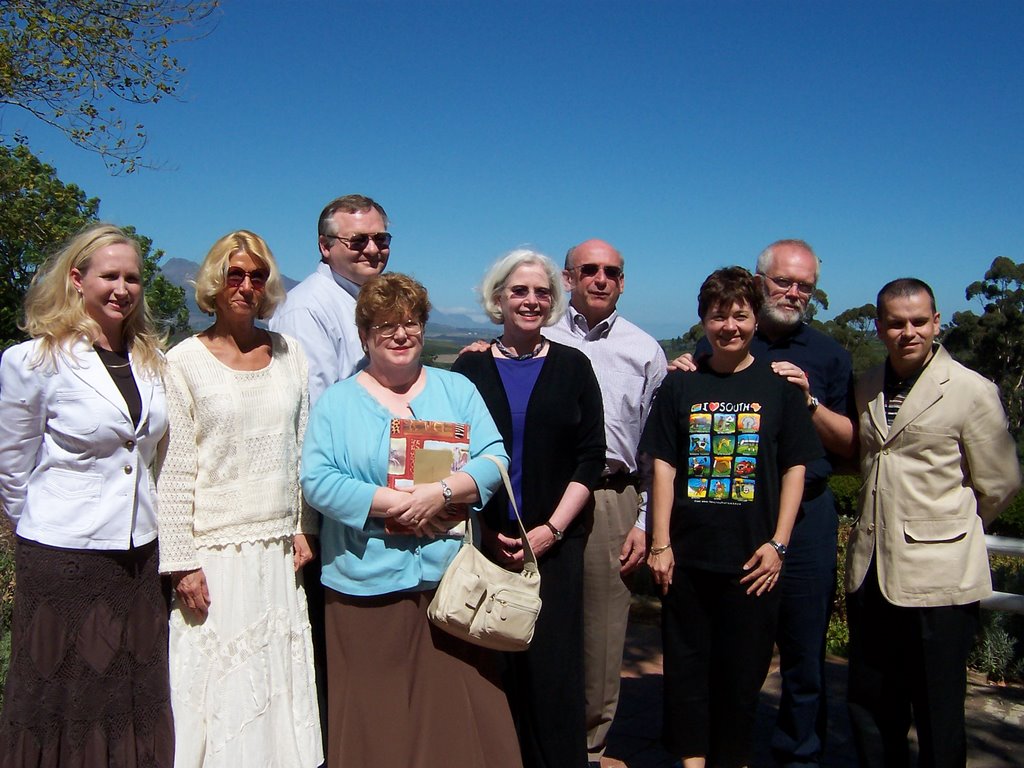
Members of the faculty of the School of Leadership Studies at Regent University recently co-hosted the first International Conference on Values-based Leadership at the University of Stellenbosch in South Africa. We also presented and ministered at several churches and ministries during our stay in South Africa. The next International Conference on Values-based Leadership is scheduled for March 2007 in Stellenbosch. Here are a few pictures of our travels in and around Cape Town. Here is a link to a news release on our trip:
http://www.regent.edu/acad/sls/newsletter/2006/april/southafrica.htm

Friday, May 12, 2006

Dreaming with Open Eyes: Leadership and Kenotic Spirituality


“When we open our eyes and dream, we open our eyes.”
– Sam Phillips[1]
[1] Phillips, S 2001. How to Dream; from Fan Dance. Nonesuch Records.

The study of leadership is concerned with the understanding of reality. It is the pursuit of a deepening knowledge of how our world actually works. Joseph Jaworski[1] echoes this notion when he writes: “It’s not about positional power; it’s not about accomplishments; it’s ultimately not even about what we do. Leadership is about creating a domain in which human beings continually deepen their understanding of reality and become more capable of participating in the unfolding of the world. Ultimately, leadership is about creating new realities.” Authentic leadership is marked by an active engagement with the problems and the joys of the world we live in. Seen in this light, leadership is more than just the skilful application of the newest management techniques peddled by motivational gurus and it is certainly more than the capitalist catnip of economic progress at any cost. Leadership is about dreaming with our eyes open, leading whilst present in the moment and to one-another and so finding ways to participate in the creation of a better tomorrow. Christian Spirituality deeply informs this kind of leadership approach. Kenosis, as an ethical construct of the Christian doctrine of the incarnation, speaks of a very specific belief in the mode of God’s interaction with the world. In the doctrine of incarnation, the Christian claim is that God actually lived the life of a man in Jesus of Nazareth and thus the kenosis (self-emptying) of God in Christ provides an ethical and philosophical mode of ministry and leadership that is based on voluntary abasement and mutuality with all of humankind.

The spirituality of kenosis, building on the doctrinal tenets of the incarnation, positions itself in a recognition and appreciation of a specific culture; in a sense the embracing of the self’s and by implication the other’s “sitz-im-leben” (context). Appropriating the values of kenosis in leadership requires the identification and acceptance of the social and cultural locality of the self and the other as the beginning point in the (re)building of community. Leaders with the values of kenosis can be been described as characterised by, voluntary self-limitation, vulnerability, present to the other, voluntary powerlessness, continual purification from self-centeredness, humility, self-sacrifice, and openness to the other. Kenosis addresses the true challenge of dialogical behaviour and as appropriated in the Christian past was often rooted in a mimetic re-enactment of the self-emptying (kenotic) Christ. This reading of kenosis[1] became the hermeneutical key for Christian leaders in the past in which they interpreted the birth, life, death and resurrection of Jesus Christ and applied its meaning to leadership within their own temporal context. Kenosis was often seen as a mystical communion with the kenotic Christ that leads to personal transformation of both the leader and follower and enabled them to practice kenosis (self-emptying) as Christ did. This resolute divesting of the prestige and power inherent in the leadership transaction enables the leader and follower to enter into a new union that is marked by equality and service. Yves Raguin[2], a Christian thinker explains the leadership implications of kenosis, when he writes: “…kenosis, then, is the gateway to mutual understanding, and beyond this, to an intimate sharing that is the consummation of a relationship in union…By dispossession of self we are able to absorb the amazing riches of others…”.

The value of mutuality in kenosis allows the leader to transcend narrow selfhood, to locate the other in love and to truly enter into the world of the follower where the leader becomes the servant of the other. This is a state of mutual acceptance, vulnerability and receptivity. This overcoming of the separation between leader and follower finds it deepest dimension in kenotic love and self-sacrifice that negates, in the words of Thomas Merton[3], the “dream of separateness” that so often pervades organisational leadership. The central value of mutuality in the theological and ethical construct of kenosis allows the leader to locate the follower in their mutual humanity and so find their deepest identity in a communal, redefining, and empowering relationship of self-sacrificial love.

[1] For a full treatment on the theological and ethical ramifications of the concept of kenosis see Cronin, K M 1992. Kenosis. Rockport: Element.
[2] Raguin, Y 1973. I am sending you (John 22:21): Spirituality of the Missioner. Manila: East Asian Pastoral Institute. Page 111.
[3] Merton, T 1966. Conjectures of a guilty bystander. New York: Doubleday. Page 156.
[1] Jaworski, J 1998. Synchronicity: The Inner Path of Leadership. San Francisco: Berrett-Koehler Publishers. Page 3.