Sunday, December 31, 2006

A Moment in Time

As we mark the end of this year and the beginning of another may we discover God's continued active involvement in our hearts and in this world. The Gospel of Mark describes the beginning of such a "new time" in an inaugural, abbreviated sermon of Jesus in his first chapter (1:15): "The time has come," He said. "The kingdom of God is near. Repent and believe the good news!"
Ancient Greek has two words for time, "chronos" and "kairos". "Chronos" refers to chronological or sequential time and "kairos" signifies a "moment in time", a special occasion when chronological time is interrupted when something momentous, special takes place. In certain Orthodox Churches, before the liturgy begins, the deacon proclaims to the minister, "It is time (kairos) for the Lord to act", indicating that the time of the worship is an intersection with God and thus Eternity. The Lutheran theologian, Paul Tillich described "kairos" as the Greek category of history and therefore time that marks significant turning points, "occasions of depth rather than events continuing the normal chronometric measure of time." The coming of Jesus into our world, leadership and communities is such a "kairos" moment. May this new year be a "kairos" event that in the words of Paul Tillich becomes a: "moment at which history has matured to the point of being able to receive the breakthrough of the manifestation of God." Have a blessed and God-filled New Year!

Friday, December 29, 2006

Joy in work

"There can be no joy in living without joy in work." - Thomas Aquinas

We live in a generation where work is considered a "necessary evil", a means to an end, and an avenue to secure wealth and provision for the "real life" that occurs outside of work time. The wisdom from the wealth of Christian thought on this speak of another reality: Work as a way to imitate God, as a kind of occupational therapy and a God-given blessing. The Desert Fathers and Mothers in the Fourth and Fifth Centuries understood something of this therapeutic nature of God-given work. It is said in the Philokalia (the collection fo writings of the Desert Fathers and Mothers, literally called "The Beautiful Writings") that one of the Fathers, called Abba Paul "proved that without working with his hands a monk cannot endure to abide in his place, nor can he climb any nearer the summit of holiness." This perspective finally gave place later to Benedict's monastic maxim of "Ora et Labora" (work and prayer) that reminds all of us that these two activities work together and are complimentary dimensions of a "whole and holy life".

Monday, December 25, 2006

Christmas Greetings

Have wonderful Christ-filled Christmas! I look forward with great anticipation to our continued interaction and the beginning of a new year and the promise it holds of God's leading and blessing.

Saturday, December 23, 2006

First Edition of JBPL and Date of Research Roundtable

It is with great joy that I can announce that the first edition of the Journal of Biblical Perspectives in Leadership is online today. I am very grateful for all the hard work by the production staff to get this first edition ready.
Here is a link to it:

I am also including the text of the invitation to the first Research Roundtable on Biblical Perspectives in Leadership:

The School of Global Leadership and Entrepreneurship of Regent University will host the inaugural Biblical Perspectives in Leadership Research Roundtable on May 8, 2007 at the Founders Inn and Conference Center located on the campus of Regent University in Virginia Beach, VA.

The Biblical Perspectives in Leadership Research Roundtable is an attempt to create a platform of discussion and exploration where scholars, researchers, ministers and practitioners who are interested in research and exploration of leadership studies focused on the Hebrew and Christian scriptures can present and test their research. The roundtable invites papers and discussion forums covering topics such as:

  • The use of exegetical methods to explore leadership

  • The relationship between scripture, faith, theology and leadership

  • Models of biblical spirituality and leadership

  • Models of tribal and other forms of leadership in the Pentateuch

  • Models of ruling, leadership, governing and organizational structures in the history of early Israel

  • Leadership values in the wisdom writings of the Hebrew scriptures

  • The relationship between prophecy and contextual leadership in the prophetic material of the Hebrew scriptures

  • Comparative studies of leaders and leadership models across the Hebrew and Christian scriptures

  • Historical studies of leaders in the Hebrew and Christian scriptures
    Group dynamics in the Gospels

  • Historical Jesus and leadership research

  • Pauline perspectives in leadership

  • Organizational design and dynamics in the early faith communities of the Christian scriptures

  • Follower-leader relationships in the Christian scriptures

  • Organizational and leadership values in the Christian scriptures

  • Models of spiritual and leadership formation in the Christian scriptures

  • Models of future studies and strategic foresight in the apocalyptic material of the Hebrew and Christian scriptures

Please contact Dr. Corné Bekker, the editor of the Journal for Biblical Perspectives in Leadership (JBPL) for further details regarding the registration costs, program and submission guidelines. He can be reached at clbekker@regent.edu

Thursday, December 21, 2006

Christmas Message from Dr. Bruce Winston

Here is a link to a wonderful Christmas audio message from Dr. Bruce E. Winston, the Dean of the School of Global Leadership and Entrepreneurship at Regent University. In this message Dr. Winston illustrates God 's use of organizations and leaders in accomplishing His work as seen in the Gospel story of the birth of Jesus.

For your convenience, the audio message is provided in two audio formats below.

Real Media: http://real.regent.edu:8080/ramgen/schgle/misc/2006_christmas.rm

Microsoft Windows Media: http://media.regent.edu/schgle/misc/2006_christmas.wma

Advent Season: Towards Incarnational Leadership - Reflection 4

My family loves Christmas. My wife, being Italian, always decorates our house with beautiful ornaments for Christmas - the focus of all the decorations a simple wooden creche (French for manger) depicting the birth of Jesus. My son played the part of a shepherd in a re-enactment of the nativity story, this last Sunday in church. Both these practices, the display of a creche and a "live" nativity play, go back to the life of the Christian leader, Francis of Assisi. Francis was deeply taken by the miracle of the incarnation and in an attempt to bring his audience back to the simplicity and humility of the birth of Jesus, created the first living nativity play in a small cave in Umbria, Italy in 1223. On Christmas eve of that year, he gathered with other believers to act out the birth of Jesus in all it's impoverished glory. Francis even included two animals: an ox and a donkey. He chose these animals in a materful attempt to reference Isaiah 1:3 which states:
"The ox knows its owner, and the ass its master's crib; but Israel does not know, my people does not understand."
Bonaventure, the biographer of Francis (died in 1274) tells this story in his "Life of St. Francis" and reports the miracles that came from this "performing of the Gospel":
"It happened in the third year before his death, that in order to excite the inhabitants of Grecio to commemorate the nativity of the Infant Jesus with great devotion, [St. Francis] determined to keep it with all possible solemnity; and lest he should be accused of lightness or novelty, he asked and obtained the permission of the sovereign Pontiff. Then he prepared a manger, and brought hay, and an ox and an ass to the place appointed. The brethren were summoned, the people ran together, the forest resounded with their voices, and that venerable night was made glorious by many and brilliant lights and sonorous psalms of praise. The man of God [St. Francis] stood before the manger, full of devotion and piety, bathed in tears and radiant with joy; the Holy Gospel was chanted by Francis, the Levite of Christ. Then he preached to the people around the nativity of the poor King; and being unable to utter His name for the tenderness of His love, He called Him the Babe of Bethlehem. A certain valiant and veracious soldier, Master John of Grecio, who, for the love of Christ, had left the warfare of this world, and become a dear friend of this holy man, affirmed that he beheld an Infant marvellously beautiful, sleeping in the manger, Whom the blessed Father Francis embraced with both his arms, as if he would awake Him from sleep. This vision of the devout soldier is credible, not only by reason of the sanctity of him that saw it, but by reason of the miracles which afterwards confirmed its truth. For the example of Francis, if it be considered by the world, is doubtless sufficient to excite all hearts which are negligent in the faith of Christ; and the hay of that manger, being preserved by the people, miraculously cured all diseases of cattle, and many other pestilences; God thus in all things glorifying his servant, and witnessing to the great efficacy of his holy prayers by manifest prodigies and miracles."
Bonaventure's story contains an important lesson for those interested in Christian Leadership. Francis desired to "perform the Gospel" instead of merely preaching it and thus miracles ensued from this simple event. "Manifest prodigies and miracles" will follow us when we allow the values of Jesus to be "incarnated" in our leadership behavior and practices.
"The Word became flesh and made His dwelling among us. We have seen His glory, the glory of the One and Only, who came from the Father, full of grace and truth." (John 1:14)

A Long View of History

I found two interesting interactive maps this morning that track the world-wide growth of religion and the imperial history of the middle-east. These interactive maps from a website called "Maps of War (www.mapsofwar.com)" can be found at the following links:
Imperial History of the Middle East:

History of Religion:

I wonder how much of the "Christian conquests" in history actually served the message of the Gospel. What is the message of the Gospel? How do we go about ministering/preaching/teaching the message of Jesus with integrity in this divided world of ours? What kind of Christian Leadership will bring about authentic transformation?

It remains my conviction that a long view of history coupled with a clear understanding of the Hebrew and Christian Scriptures hold the promise of a resurgence of the kind of Christian Leadership that will change the world.

Tuesday, December 19, 2006

The Joys of Zero

I am re-reading Dallas Willard's great book on the Gospel of Jesus, "The Divine Conspiracy" this week and kept going back to the centrality of the "secrecy motif" in the service that Jesus asks for in the Gospels of Matthew and Mark. It seems that this call to secret service remains an important, if not central, element in the recovery of authentic Christian Leadership.

Willard's great contribution in this book is that he links the Gospel call to secret service (or service in obscurity) with freedom from dependency on reputation and material wealth - precisely the "stuff" contemporary leadership studies are so enthralled by.

As I am re-reading this provocative book I could not help but to hear Sam Phillips singing in the background. The inherent falseness of the promises of power and prestige is a common theme that runs through the lyrics of her songs. One example is the lyrics of the song "Zero, Zero, Zero" from her very experimental disk: "Omnipop: It is only a fleshwound Lampchop":

Big numbers go by
I close my eyes
I never count a large amount
My lucky number is below one
You never know when you might need a zero

The zero in my hand
is nothing to lose
It's hard to confuse power with love
love with power
Everything that I'm not is all that I've got

Shane Helmer reviews Phillips' Omnipop and picks up on this central theme of power/powerlessness in her music:
"Pop culture seems obsessed with its own definition of success. Money and power equate with popularity and position. Those who do not fit neatly into the equation are continuously reminded by pop culture icons, who ironically have achieved such success, that they are zeros in society. Admittedly, 'regular folk' feel powerless sometimes. But to have this perception so intricately woven into our culture's consciousness robs us of our enthusiasm for living and crushes our dreams beneath the cynical wreckage of society. There seems to be far too much whining and not enough constructive criticism. It is into this tension, this world of zero-speak, that singer-songwriter Sam Phillips wedges a truly alternative perspective."

The question of what to do with power remains an important element in our search for authentic, Biblical Leadership.

Further Reading:
"Sam Phillips' sardonic look at popular culture" by Shane Helmer. Music Review: Omnipop (It's Only a Flesh Wound Lambchop) by Sam Phillips. (Virgin Records: 1996).
"The Divine Conspiracy" by Dallas Willard. HarperSanFrancisco (1998).

Thursday, December 14, 2006

Leadership Talks: The Values of Incarnational Leadership

I did a recording last week for Leadership Talks entitled "The Values of Incarnational Leadership". Here is a synopsis of the talk:
"The celebration of the birth of Jesus during this advent season is an opportunity to revisit the Christian doctrine of the Incarnation and the implication this biblical belief has on the quest for authentic Christian leadership. Incarnational leadership is an attempt to imitate the self-emptying act of Jesus as the Word made flesh that came to dwell among us. Incarnational leadership promotes a leadership approach that values embracing the humanity of others and active humility. This leadership approach asks for Christologically grounded, humble courage where followers are redefined in terms of praxis and not propinquity. This leadership praxis is one of charity, identification of those being led and of authentic love."

Here is a link to Leadership Talks:

Tuesday, December 12, 2006

John Calvin on the role of Scripture in the formation of Ethical Conduct

I have been re-reading Calvin this week and especially his understanding of the role of Scripture in the formation of ethical conduct. Calvin comments that when we devote ourselves to the study of Scripture that this devotional discipline aids in the values conversion the Gospel demands:

"This is also evidence of great progress: that, almost forgetful of ourselves, surely subordinating our self-concern, we try faithfully to devote our zeal to God and his Commandments. For when scripture bids us leave off self-concern, it not only erases from our minds the yearning to possess, the desire for power, and the favor of men, but it also uproots ambition and all craving for human glory and other more secret plagues. Accordingly, the Christian must surely be so disposed and minded that he feels within himself it is with God he has to deal throughout his life. In this way, as he will refer all he does to God's decision and judgment, so will he refer his whole intention of mind scrupulously to Him... “
We seem to have lost something today of the formative power of reading and studying God's Word.

For more on this see Luder G. Witlock’s excellent article, “Spiritual direction in the Reformed tradition.” in the Journal of Psychology and Theology. December, 2002.

Monday, December 11, 2006

Advent Season: Towards Incarnational Leadership - Reflection 3

A good friend of mine directed me to an advent sermon by Thomas Merton that I have not seen before. Merton makes use of the Lukan observation that there was no room for Joseph, Mary and Jesus to eplore the message of values reversal present in the Gospel birth narratives. The implications for Christian leadership is obvious:
"Into this world, this demented inn, in which there is absolutely no room for him at all, Christ has come uninvited. But because he cannot be at home in it - because he is out of place in it, and yet must be in it - his place is with those others who do not belong, who are rejected because they are regarded as weak; and with those who are discredited, who are denied the status of persons, and are tortured, exterminated. With those for whom there is no room, Christ is present in this world. He is mysteriously present in those for whom there seems to be nothing but the world at its worst. For them, there is no escape even in imagination. They cannot identify with the power structure of a crowded humanity which seeks to project itself outward, anywhere, in a centrifugal flight into the void, to get out there where there is no God, no man, no name, no identity, no weight, no self, nothing but the bright, self-directed, perfectly obedient and infinitely expensive machine.

For those who are stubborn enough, devoted enough to power, there remains this last apocalyptic myth of machinery propagating its own kind in the eschatological wilderness of space - while on earth the bombs make room!

But the others: they remain imprisoned in other hopes, and in more pedestrian despairs, despairs and hopes which are held down to earth, down to street level, and to the pavement only: desire to be at least half-human, to taste a little human joy, to do a fairly decent job of productive work, to come home to the family...desires for which there is no room. It is in these that He hides himself, for whom there is no room."

Link to the full text of the sermon:

Friday, December 08, 2006

The Birth of Jesus in the New Testament

I wrote a short introduction to the birth narratives of Jesus in the Gospels of the New Testament for cbn.com this week. The following is the conclusion of the article and a call for a rediscovery, appreciation and application of these powerful narratives:
The four Gospels in the New Testament present four unique and yet complimentary pictures of Jesus -- and this is evident in the way they record the birth of Jesus: Matthew presents Jesus as the King of the Jews worthy of obedience and worship; Luke shows a humane Savior that brings good tidings and liberation to the poor, neglected and marginalized; Mark present Jesus as Lord that serves in secret and thus shows a new way, free from the fight for supremacy and status; and finally, John presents Jesus as God, who comes as the Word become flesh and this shines in the darkness to bring a new beginning in this world. May we use this advent season and time of celebration to rediscover the powerful birth narratives in the Gospels of the New Testament.

Here is a link to the full article:

Thursday, December 07, 2006

Advent Season: Towards Incarnational Leadership - Reflection 2

I read an interesting comparison between institutional and incarnational leaders a few days back on a leadership blog. I am not sure that they are competing or even differing models (things are never as simple as this) - but is well worth the read and does help to refine our thoughts in our on-going quest to recover an incarnational approach in leadership. The blog includes the following comparison:

* Institutional leaders lead because the institution has passed them as fit to lead.
* Incarnational leaders lead because they emerge from being rooted in a community into recognised leadership.

* Institutional leaders carry their own style into the church and shape it to their preference.
* Incarnational leaders only get to lead because their style fits with the culture of the community they lead

* Institutional leaders are vested with power and authority by the institution.
* Incarnational leaders are granted their power and authority by the community they lead.

* Institutional leaders can still hold leadership positions whether or not they practice what they preach.
* Incarnational leaders can not assume that same luxury (or indulgence?).

* Institutional leaders can live off the admiration and adulation of the congregation.
* Incarnational leaders must continually re-earn their place as leaders. Their power and respect rises and falls with the perceived level of their integrity, authenticity, and deep commitment to the life of the community.

Here is a link to the original blog:
http://craftycurate.blogs.com/pilgrims_progress/2004/10/leadership_inst.html

Wednesday, December 06, 2006

New Book on the Spirituality of Henri Nouwen

There is a new book out on the Spirituality of Imperfection of Henri Nouwen by Wil Hernandez. Nouwen remains an important source and for the on-going quest in the recovery of authentic Christian Leadership. The following is a link to this new book at Amazon.com:
http://www.amazon.com/Henri-Nouwen-Spirituality-Imperfection-Hernandez/dp/0809144344/sr=1-1/qid=1165288616/ref=pd_bbs_sr_1/103-2415131-3367037?ie=UTF8&s=books

Nouwen's great contribution to our understanding of Christian Leadership is best summarized in his book: "In the Name of Jesus: Reflections on Christian Leadership." Nouwen wrote this book shortly after he left a position of great status and privilege at Harvard University to go and live amongst mentally handicapped people in the L'Arche Community. The following excerpt from this book show Nouwen's theology of voluntary self-limitation as the first step in the recovery of authentic Christian Leadership:

"The first thing that struck me when I came to live in a house with mentally handicapped people was that their liking or disliking of me had absolutely nothing to do with any of the many useful things I had done until then. Since nobody could read my books, my books could not impress anyone, and since most of them never went to school, my twenty years at Notre Dame, Yale and Harvard did not provide a significant introduction.… Not being able to use any of the skills that had proved so practical in the past was a real source of anxiety. I was suddenly faced with my naked self, open for affirmations and rejections, hugs and punches, smiles and tears, all dependent on how I was perceived at the moment. In a way, it seemed as though I was starting my life all over again. Relationships, connections, reputations could no longer be counted upon. This experience was and, in many ways, is the most important experience of my new life because it forced me to rediscover my true identity. These broken, wounded and completely unpretentious people forced me to let go of my relevant self—the self that can do things, show things, prove things, build things—and forced me to reclaim that unadorned self in which I am completely vulnerable, open to receive and give love regardless of any accomplishments.”

Tuesday, December 05, 2006

Advent Season: Towards Incarnational Leadership - Reflection 1

I recorded a short audio recording today on the call to incarnational leadership found in the birth narratives of Jesus in the Gospels of the New Testament. The following quote from Bill Robinson, the president of Whitworth College in Spokane, Washington goes a long way to define the call to incarnational leadership:
"If God Incarnate pitched his tent right in the middle of those whom he led–those whom he called his friends–what should we as leaders do? I have become convinced that the best place from which to lead is not above our people, not in front of our people, not under our people, and not on our cell phones with our people. The most powerful position of leadership is dwelling among those God calls us to lead. As Jesus emptied himself to take on the form of a bond-servant (Philippians 2:5, 6), we must empty ourselves of the pretenses and privileges that create distance between us and our people. Pedestal leadership is perpetuated by those who enjoy sitting on the pedestal. I’m still waiting to hear an hourly employee complain that our leaders need to be more aloof. Until that happens, our best bet for inspiring those we lead is to follow the example of Jesus."

May the Word become Flesh in our Leadership.
Link fo Full Article:

Monday, December 04, 2006

Leadership that embraces Humanity

Discussions on the interpretation of Christ “being found in appearance as a man” (σχήματι εὑρεθεὶς ὡς ἄνθρωπος) in the Philippians hymn has been traditionally riddled with controversy and rigorous debate (Howard 1978, 368). Re-reading the hymn as an ethical exemplum has opened a new and promising avenue for a discussion on the social values that the hymn proposes in a society riddled with social inequalities and thus holds many practical applications for Christian leadership. Albert Nolan (1977, 135), in his response to apartheid in South Africa, used the Philippians hymn to construct a new perspective in ontological Christology that demands a new appreciation of the humanity of Christ and thus of others:

“Whatever humanity and divinity may mean in terms of a static philosophy of
metaphysical natures, in religious terms for the man who recognizes Jesus as
his God, the human and the divine has been brought together in such a way
that they now represent one and the same religious value. In this sense
Jesus’ divinity is not something totally different from His humanity. Jesus’
divinity is the transcendent depth of His humanity. Jesus was immeasurably
more human than other men…”

Regardless of some of the obvious theological difficulties of some of Nolan’s arguments, his Christology does open exciting possibilities in ethical discussions in leadership and service.

In embracing the His own humanity and thus the humanity of others, Jesus “redefined neighbor in terms of praxis, not propinquity” (Sorenson 2004, 461). This “praxis” is one of charity, identification with the one being served and of authentic love. Vanstone (1978) has developed a phenomenology of love in which he characterizes three characteristics of authentic love (Gregerson 2003, 371-372). Authentic love is limitless, precarious and vulnerable (Vanstone 1978, 44-51).
  • Authentic love therefore does not impose boundaries on others (limitless) but “accepts without limit the discipline of the circumstances” (Vanstone 1978, 44),

  • is precarious in that it avoids the “the distortion of possessive control” (Gregerson 2003, 372)

  • and finally true love revels in being vulnerable in that it gives the one loved a “power that could not otherwise be there” (Vanstone 1978, 51).

Christian Leadership that takes the call to Christological mimesis seriously will exhibit this embracing of humanity in love that is limitless, precarious and vulnerable.

Further Reading:

Howard, G. 1978. Phil. 2:6-11 and the Human Christ. Catholic Biblical Quarterly 40(3): 368-387.

Nolan, A. 1977. Jesus before Christianity. Cape Town: David Phillips.

Sorenson, R. L. 2004. Kenosis and Alterity in Christian Spirituality. Psychoanalytic Psychology. Vol. 21, No. 3, 458-462.

Vanstone, W. H. 1978. The Risk of Love. New York: Oxford University Press.

Thursday, November 30, 2006

The Dark Night of the Soul

I am presenting a lecture later today on the approach to spiritual direction of the Spanish Reformers of the 15th century: John of the Cross and Teresa of Avila. John of the Cross remains an important guide in the quest for authentic Christian formation and thus leadership.

John's image of the "dark night of the soul" as a necessary step in our formation and journey towards God stands unmatched. He says it best in his famous poem:

One dark night, fired with love's urgent longings
ah, the sheer grace!
I went out unseen, my house being now all stilled.
In darkness, and secure, by the secret ladder, disguised
ah, the sheer grace!
in darkness and concealment, my house being now all stilled.
On that glad night, in secret, for no one saw me,
Nor did I look at anything, with no other light or guide than the one that burned in my heart
This guided me more surely than the light of noon
To where He was awaiting me
Him I knew so well
there in a place where no one appeared
O guiding night!
O night more lovely than the dawn!
O night that has united the Lover with his beloved,
transforming the beloved in her Lover.
Upon my flowering breast, which I kept wholly for Him alone,
There He lay sleeping, and I caressing Him there in a breeze from the fanning cedars.
When the breeze blew from the turret, as I parted His hair,
It wounded my neck with its gentle hand, suspending all my senses.
I abandoned and forgot myself,
laying my face on my Beloved.
All things ceased; I went out from myself, leaving my cares forgotten among the lilies.

Wednesday, November 29, 2006

Silence and Leadership

I am re-reading portions of the Philokalia (the Sayings of the Desert Fathers and Mothers) as part of my morning devotions and am struck once again by the centrality that these sayings give to ethical conduct in leadership. The connection between the "control of the tongue" and ethical conduct is often made by these early Christian hermits. Two stories from this time will suffice to illustrate this point:

Abba Isidore of Pelusia said: Living without speaking is better than speaking without living. For a person who lives rightly helps us by silence, while one who talks too much merely annoys us. If, however, words and life go hand in hand, it is the perfection of all philosophy.

Abba Poemen said: There is one sort of person who seems to be silent, but inwardly criticizes other people. Such a person is really talking all the time. Another may talk from morning to night, but says only what is meaningful, and so keeps silence.

May we learn the wisdom of silence.

Tuesday, November 28, 2006

To be a Disciplined Disciple

I am reminded this morning of the semantic similarity between the concepts of discipline and disciple. To be a disciple/follower of Jesus is to live a disciplined life. Thomas Merton describes this commitment to a disciplined life in the language of the appropriation of the cross of Jesus. To experience the "discipline of the cross" is to move from an ego-affirming spirituality to an ego-transcended approach to life and leadership. The contributions that this make in our search for authentic leadership are obvious.
Merton writes:
“But basically, the discipline involved here is that of a crucifixion which eliminates a superficial and selfish kind of experience and opens to us the freedom of a life that is not dominated by egoism, vanity, willfulness, passion, aggressiveness, jealousy, greed. Finally, discipline means solitude of some sort, not in the sense of selfish withdrawal but in the sense of an emptiness that no longer cherishes the comfort of various social ‘idols” and is not slavishly dependent on the approval of others. In such solitude one learns not to seek love but to give it. One’s great need is now no longer to be loved, understood, accepted, pardoned, but to understand, to love, to pardon and accept others just as they are, in order to help them transcend themselves in love.”

Source:
Thomas Merton. “Renewal and Discipline” in Contemplation in A World of Action (New York, Doubleday and Company, Inc.): 131-132.

Monday, November 27, 2006

Winning at any Cost?

I have been travelling, speaking and ministering for the last month, and so have not had the oppertunity to blog. This has been a providential time for me with lots of time for prayer, study and reflection. I continue to be taken by the extra-ordinary levels of competitiveness amongst Christian leaders. We compare and compete with one another and in a mad rush for legitimacy construct elaborate systems/ideologies that ensure that the world and the church know/acknowledge that we are the best, the greatest and on top. We parade our strengths, list our accomplishments, argue how only "our group/ordinations" can be traced back to the early Church (and thus to Jesus) and conduct an endless advertisement campaign to prove that all others are wrong and we are right. I wonder how this is different to the current "war" between certain fanatic Islamic groups and the Western world. But is it really about "winning"? Where is the "signature" of Jesus in the church and larger world today? How can we mirror the love, mercy and salvation that Jesus offers, if our greastest value is triumphing over others?
The Franciscan singer, song-writer and leader, John Michael Talbot writes in his Thanksgiving Letter to his Community about the need for authentic Christian leadership: "If we truly began to grasp the meaning of what it is to be 'Christian,' or 'like Christ,' we would shake the world, and in a good way! A revolution of Love would spread across the planet like a healing fire, and across the oceans like a life-giving tsunami! For the authentic follower of Jesus, this is done by really giving witness to Jesus, not through religious fundamentalism and fanaticism, but through a radicalism (or rootedness) that is willing to truly live the way that Jesus lived. Jesus changed the world with only 12 apostles. Are there twelve who will respond, or 120, 12,000, or 12 million? What would happen if we would all dare to do this? We would change the world, and for the better."
The only one that never suffered from a messianic complex was the one that was/is the Messiah.
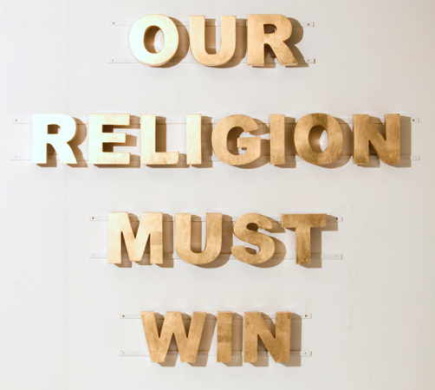
Picture:
Brett Murray (2005): "Our religion must win". Goodman Gallery.

The Future according to Jesus

I got word last week, whilst travelling in South Africa, that our proposal for a panel presentation on the future acoording to Jesus at the World Future Association's International Conference in 2007 has been accepted. Lots of thanks and appreciation go to Jay Gary (PeakFutures, Colorado Springs: USA) and Tsvi Bisk (Center for Strategic Futurist Thinking, Jerusalem: Israel) for graciously inviting me to do this presentation with them. Here is an abstract of our presentation:

The Future According to Jesus
Futurists often encounter religionists who hold views that undercut future-oriented behavior, including determinism, fatalism, or millennial beliefs. But as a Palestinian Jew, what was Jesus’ real view of the future? And how does that view compare with that of futurists who focus on “this world,” rather than the next? Drawing on historical Jesus research, this session identifies three driving forces of the first century, and argues that Jesus rejected the conventional and counter-futures of His time to envision a creative future for His generation. This first-century foresight will then be compared and contrasted with 21st century global scenario frameworks to consider how visionary leadership might shift society's deeply ingrained attitudes toward impending conflicts and catastrophes.

Who should attend: Any futurist who has encountered resistance to futures thinking from religionists.


What you’ll learn: Participants will learn how to ground foresight in the historical world of Jesus, and relate religious concepts to futures thinking and contingency planning.


How this knowledge can be applied: Attendees will learn how to generate “third way” scenarios that seek to transcend the clash of mainstream and side stream futures.

Monday, October 30, 2006

Developments in African Leadership

I am chairing another panel presentation (this week at the International Leadership Assocation [ILA] Conference in Chicago) on African Models of Leadership entitled, "Developments in African Leadership: A Renaissance of Values-based Leadership Approaches", with Drs. Jeff Hale, Kathleen Patterson and Bruce Winston. Here follows an abstract of the presentation:

In this session, four papers present a survey of values-based approaches in contemporary African leadership. Bekker illustrates how the African practice of affective community and fundamental humanity in the Southern African social philosophy of ubuntu allows for the construction of a value–based approach of leadership in post-apartheid South Africa where leader and follower attain full humanity through a liberative, empowering relationship of mutuality. Hale proposes a theoretical model of cross-cultural leadership in West-Africa. The model proposed in this presentation unfolds from the literature relating to the current leadership crises in West Africa, West African culture, West African leadership, Servant Leadership Theory, and Transformational Leadership Theory. Generalized characteristics derived from the literature review described West African culture and leadership. An analysis of these general characteristics yields a composite list of West African leadership characteristics. These characteristics harmonize and integrate with the variable sets of servant leadership, transformational leadership, and principles of spiritually/divinely empowered leadership. Patterson’s presentation is a research report on servant leadership, specifically considering servant leadership theory in a Kenyan context with a focus on the Swahili concept of Harambee, meaning pulling together and embodies and reflects the value of mutual assistance, joint effort, mutual social responsibility, and community self-reliance. And, finally, Winston presents a case study of a South African fast-food company exploring the deliberate use of paternalistic/clan leadership style at the store level, a transactional leadership style at the store manager to regional manager level, and a transformational leadership style between the CEO and his direct reports at the head offices.

Towards an Understanding of Leadership and Spirituality

I am chairing a panel entitled "Towards an Understanding of Leadership and Spirituality", this week at the International Leadership Association (ILA) Conference in Chicago, with Drs. Diane Chandler, Michael Hartsfield and Karin Klenke. Here is an abstract of the session:

In this session, four papers present some of the current topics and themes that deal with research in the field of Leadership and Spirituality. Bekker proposes that the ethical and theological concept of kenosis (voluntary self-emptying) provides leaders with an alternative approach to the power games of contemporary corporate leadership. Such a kenotic approach to leadership requires a resolute divesting of prestige and power and in doing so enable the leader and follower to enter into a new relationship marked by radical equality and self-sacrificial service. Chandler reports that work overload is a casualty of the modern workplace, with leadership burnout being an unfortunate result. Chandler explores how spirituality contributes to both resilience and well-being and also impacts burnout within one group of working professionals. Hartsfield illustrates that sustainable improvement in individual and organizational performance results from leaders connecting with followers at a deeper spiritual and emotional level. This presentation considers the risk this emotional labor represents to long-term effectiveness of leaders whose leadership style is marked by a deep emotional investment in followers. And finally, Klenke presents a theoretical model that integrates leadership and spiritual development. This model draws from authentic, spiritual, self-sacrificial and the life stream model. The paper concludes with recommendations for empirical research.

Sunday, October 29, 2006

The Deceit of Pride

Pride is deceitful. A telling old Jewish joke shows the changing face of pride. In the village synagogue, during the High Holidays, the rabbi prostrates himself on the floor, saying, "God, before You I am nothing." Immediately the richest man in town prostrates himself on the floor, saying, "God, before You I am nothing." Right after that the town beggar prostrates himself on the floor, saying, "God, before You I am nothing." The rich man whispers to the rabbi,"Look who thinks he's nothing."

Dr. Paul Wong, Professor at Western Trinity University proposes the following practices in the pursuit of humilty, practices that I think translates very well to organizational leadership behavior:

* Acknowledging our wrong doing

* Receiving correction and feedback graciously

* Refraining from criticizing others

* Forgiving others who have wronged us

* Apologizing to others who have been wronged by us

* Enduring unfair treatments with patience and a forgiving spirit

* Thinking and speaking about the good things of other people

* Rejoicing over other people's success

* Counting our blessings for everything, good and bad

* Seeking opportunities to serve others

* Willing to remain anonymous in helping others

* Showing gratitude for our successes

* Giving due credit to others for our successes

* Treating success as a responsibility to do more for others

* Willing to learn from our failures

* Assuming responsibility for our failures

* Accepting our limitations and circumstances

* Accepting social reality of discrimination and prejudice

* Treating all people with respect regardless of their social status

* Enjoying the lowly status of being an outsider and a nobody

Hellen Keller, the great teacher, once declared: "I long to accomplish a great and noble task, but it is my chief duty to accomplish humble tasks as though they were great and noble. The world is moved along, not only by the mighty shoves of its heroes, but also by the aggregate of the tiny pushes of each honest worker. "

Picture:
Kendell Geers 2006. Seven Deadly Sins (Pride). Ultra-violet Neon Sculpture. Stephen Friedman Gallery, London.

Further Reading:
Here is a link to Professor Wong's essay on humility:
http://www.meaning.ca/articles/presidents_column/humility_nov03.htm

Thursday, October 26, 2006

Lead as by the Spirit

I read the following, this morning, from the wonderful "Counsels of Light and Love" of the 16th century Spanish Christian leaders, John of the Cross:

"Directors should reflect on these two things:that they are not the chief agent, guide and mover of souls,but that the principal guide is the Holy Spirit, Who is never neglectful of souls;and that they are instruments for guiding souls in faith and the love of God,according to the spirit God gives each one."

This is good and prudent advice.