Monday, October 30, 2006

Developments in African Leadership

I am chairing another panel presentation (this week at the International Leadership Assocation [ILA] Conference in Chicago) on African Models of Leadership entitled, "Developments in African Leadership: A Renaissance of Values-based Leadership Approaches", with Drs. Jeff Hale, Kathleen Patterson and Bruce Winston. Here follows an abstract of the presentation:

In this session, four papers present a survey of values-based approaches in contemporary African leadership. Bekker illustrates how the African practice of affective community and fundamental humanity in the Southern African social philosophy of ubuntu allows for the construction of a value–based approach of leadership in post-apartheid South Africa where leader and follower attain full humanity through a liberative, empowering relationship of mutuality. Hale proposes a theoretical model of cross-cultural leadership in West-Africa. The model proposed in this presentation unfolds from the literature relating to the current leadership crises in West Africa, West African culture, West African leadership, Servant Leadership Theory, and Transformational Leadership Theory. Generalized characteristics derived from the literature review described West African culture and leadership. An analysis of these general characteristics yields a composite list of West African leadership characteristics. These characteristics harmonize and integrate with the variable sets of servant leadership, transformational leadership, and principles of spiritually/divinely empowered leadership. Patterson’s presentation is a research report on servant leadership, specifically considering servant leadership theory in a Kenyan context with a focus on the Swahili concept of Harambee, meaning pulling together and embodies and reflects the value of mutual assistance, joint effort, mutual social responsibility, and community self-reliance. And, finally, Winston presents a case study of a South African fast-food company exploring the deliberate use of paternalistic/clan leadership style at the store level, a transactional leadership style at the store manager to regional manager level, and a transformational leadership style between the CEO and his direct reports at the head offices.

Towards an Understanding of Leadership and Spirituality

I am chairing a panel entitled "Towards an Understanding of Leadership and Spirituality", this week at the International Leadership Association (ILA) Conference in Chicago, with Drs. Diane Chandler, Michael Hartsfield and Karin Klenke. Here is an abstract of the session:

In this session, four papers present some of the current topics and themes that deal with research in the field of Leadership and Spirituality. Bekker proposes that the ethical and theological concept of kenosis (voluntary self-emptying) provides leaders with an alternative approach to the power games of contemporary corporate leadership. Such a kenotic approach to leadership requires a resolute divesting of prestige and power and in doing so enable the leader and follower to enter into a new relationship marked by radical equality and self-sacrificial service. Chandler reports that work overload is a casualty of the modern workplace, with leadership burnout being an unfortunate result. Chandler explores how spirituality contributes to both resilience and well-being and also impacts burnout within one group of working professionals. Hartsfield illustrates that sustainable improvement in individual and organizational performance results from leaders connecting with followers at a deeper spiritual and emotional level. This presentation considers the risk this emotional labor represents to long-term effectiveness of leaders whose leadership style is marked by a deep emotional investment in followers. And finally, Klenke presents a theoretical model that integrates leadership and spiritual development. This model draws from authentic, spiritual, self-sacrificial and the life stream model. The paper concludes with recommendations for empirical research.

Sunday, October 29, 2006

The Deceit of Pride

Pride is deceitful. A telling old Jewish joke shows the changing face of pride. In the village synagogue, during the High Holidays, the rabbi prostrates himself on the floor, saying, "God, before You I am nothing." Immediately the richest man in town prostrates himself on the floor, saying, "God, before You I am nothing." Right after that the town beggar prostrates himself on the floor, saying, "God, before You I am nothing." The rich man whispers to the rabbi,"Look who thinks he's nothing."

Dr. Paul Wong, Professor at Western Trinity University proposes the following practices in the pursuit of humilty, practices that I think translates very well to organizational leadership behavior:

* Acknowledging our wrong doing

* Receiving correction and feedback graciously

* Refraining from criticizing others

* Forgiving others who have wronged us

* Apologizing to others who have been wronged by us

* Enduring unfair treatments with patience and a forgiving spirit

* Thinking and speaking about the good things of other people

* Rejoicing over other people's success

* Counting our blessings for everything, good and bad

* Seeking opportunities to serve others

* Willing to remain anonymous in helping others

* Showing gratitude for our successes

* Giving due credit to others for our successes

* Treating success as a responsibility to do more for others

* Willing to learn from our failures

* Assuming responsibility for our failures

* Accepting our limitations and circumstances

* Accepting social reality of discrimination and prejudice

* Treating all people with respect regardless of their social status

* Enjoying the lowly status of being an outsider and a nobody

Hellen Keller, the great teacher, once declared: "I long to accomplish a great and noble task, but it is my chief duty to accomplish humble tasks as though they were great and noble. The world is moved along, not only by the mighty shoves of its heroes, but also by the aggregate of the tiny pushes of each honest worker. "

Picture:
Kendell Geers 2006. Seven Deadly Sins (Pride). Ultra-violet Neon Sculpture. Stephen Friedman Gallery, London.

Further Reading:
Here is a link to Professor Wong's essay on humility:
http://www.meaning.ca/articles/presidents_column/humility_nov03.htm

Thursday, October 26, 2006

Lead as by the Spirit

I read the following, this morning, from the wonderful "Counsels of Light and Love" of the 16th century Spanish Christian leaders, John of the Cross:

"Directors should reflect on these two things:that they are not the chief agent, guide and mover of souls,but that the principal guide is the Holy Spirit, Who is never neglectful of souls;and that they are instruments for guiding souls in faith and the love of God,according to the spirit God gives each one."

This is good and prudent advice.

Wednesday, October 25, 2006

Prayer as Revolt

I received the quote below from Thomas Merton's great book "Conjectures of a Guilty Bystander" today through a listserve that I am registered with. I like the idea of prayer as revolt. How do we change sick organizations? Merton proposes that it starts with prayer:

“ ‘The saints,’ said [French author George] Bernanos [most famous for his Diary of A Country Priest], ‘are not resigned, at least in the sense that the world thinks. If they suffer in silence those injustices which upset the mediocre, it is in order better to turn against injustice, against its face of brass, all the strength of their great souls. Angers, daughters of despair, creep and twist like worms. Prayer is, all things considered, the only form of revolt that stays standing up.’

This is very true from all points of view. A spirituality that preaches resignation under official brutalities, servile acquiescence in frustration and sterility, and total submission to organized injustice is one which has lost interest in holiness and remains concerned only with a spurious notion of ‘order.’ On the other hand, it is so easy to waste oneself in the futilities of that ‘anger, the daughter of despair,’ the vain recrimination that takes a perverse joy in blaming everyone else for our failure. We may certainly fail to accomplish what we believed was God's will for us and for the Church: but simply to take revenge by resentment against those who blocked the way is not to turn the strength of one's soul (if any) against the ‘brass face of injustice.’ It is another way of yielding to it.

There may be a touch of stoicism in Bernanos' wording here, but that does not matter. A little more stoic strength would not hurt us, and would not necessarily get in the way of grace! “


Source:

Conjectures of a Guilty Bystander by Thomas Merton, New York: Doubleday & Co, Inc., 1968 edition, p. 165.

Tuesday, October 24, 2006

New Edition of Leadership Advance

The new edition of Leadership Advance came out today. There are several really good articles on effective leadership in this edition. Here is a link to this edition:

The Power of Humble Love

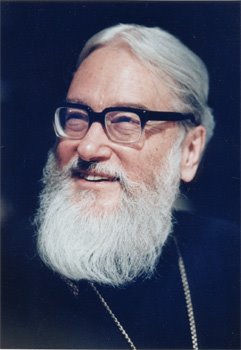
I read a great article this morning on the leadership approach of spiritual fathers and mothers in the Eastern Christian tradition by Bishop Kallistos Ware. It is a great treatment on the central values of humility and love in this approach to Christian Leadership. We need more research and thinking about the value of humility in leadership. Ware writes:

In the Eastern Orthodox tradition at its best, the spiritual father has always sought to avoid any kind of constraint and spiritual violence in his relations with his disciple. If, under the guidance of the Spirit, he speaks and acts with authority, it is with the authority of humble love. The words of Abba Zosima in The Brothers Karamazov express an essential aspect of spiritual fatherhood: "At some ideas you stand perplexed, especially at the sight of men's sin, uncertain whether to combat it by force or by humble love. Always decide, 'I will combat it by humble love.' If you make up your mind about that once and for all, you can conquer the whole world. Loving humility is a terrible force; it is the strongest of all things and there is nothing like it."
Here is a link to Bishop Kallistos' article:

Monday, October 23, 2006

Humility and Christian Scholarship

There is a very helpful article in the Fall edition of Christian Scholar's Review. Written by Roger P. Ebertz, it deals succintly with the problems connected with the "worldview" approach in Christian Scholarship and points the way to a better understanding of the role of Biblical Hermeneutics to shape and frame our role as humble seekers of Truth . Ebertz (2006:28) proposed a humble and open approach in scholarship that seeks to emulate the attitude of Jesus Christ:


"We must stand before the world and before God with the recognition that our perspectives are by necessity incomplete and limited. This humility, in turn, should lead us to be genuinely open to others. In the case of the Christian scholar I believe that this openness faces several directions. The Christian scholar is open to Scripture. She is open toward the subject matter of her field. And she is open to the voices of all of those who, also seek to understand. Although we are not used to applying concepts like 'love' and 'compassion' to the intellectual activity of scholarship, I am inclined to think that they apply. Genuine openness to another is only possible when we care what the other has to say."


Further Reader:
Ebertz, R. P. 2006. Beyond Worldview Analysis: Insights from Hans-Georg Gadamer on Christian Scholarship. Christian Scholar's Review. XXXVI:1

Friday, October 20, 2006

Leadership free from the desire to dominate

I presented a lecture yesterday on the model of Spiritual Direction used by the Desert Fathers and Mothers in the third and fourth centuries of the early Church. I was struck once again by the ethical and moral foundation of leadership presented by these wise Spiritual Fathers and Mothers. The following excerpt from the Philokalia underlines this perspective and approach to leadership:


Amma Theodora said, 'Let us strive to enter by the narrow gate, Just as the trees, if they have not stood before the winter's storms cannot bear fruit, so it is with us; this present age is a storm and it is only through many trials and temptations that we can obtain an inheritance in the kingdom of heaven.' The same Amma said that a teacher ought to be a stranger to the desire for domination, vain-glory, and pride; one should not be able to fool him by flattery, nor blind him by gifts, nor conquer him by the stomach, nor dominate him by anger; but he should be patient, gentle and humble as far as possible; he must be tested and without partisanship, full of concern, and a lover of souls.

Thursday, October 19, 2006

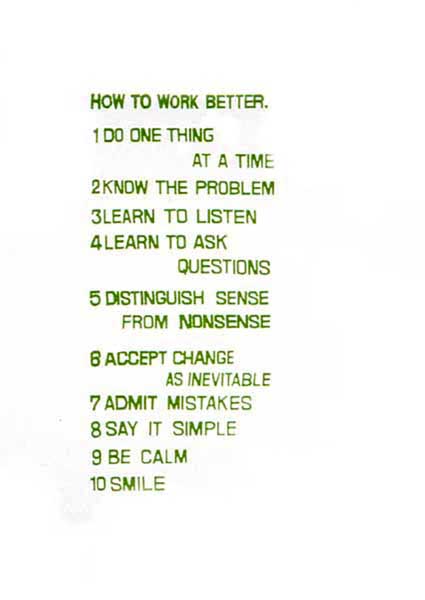
How to work better


Monday, October 16, 2006

Socio-Rhetorical Criticism and the Promise it Holds for Leadership Study

I am leading a workshop tomorrow on the use of new methods of reading Scripture and it's use in leading students in higher education and research. I have been using one of the newer approaches in reading Biblical texts, socio-rhetorical criticism, because of it's high programmatic approach and its socio-cultural focus. Vernon Robbins explains the basic premise of this approach:

"As the twentieth century ends and the third millenium begins, socio-rhetorical interpretation has become a multi-dimensional approach to texts guided by a multi-dimensional hermeneutic. Rather than being another method for interpreting texts, socio-rhetorical interpretation is an interpretive analytical approach that evaluates and reorients its strategies as it engages in multi-faceted dialogue with the texts and other phenomena that come within its purview. The approach does not claim to be comprehensive. Rather, the claim is that the approach uses the insights of sociolinguistics, semiotics and ethnography in an interactionist philosophical mode that sets ancient, modern and post-modern systems of thought in energetic dialogue with one another."

It is my growing conviction that a clearer understanding of the Hebrew and Christian Scriptures holds the promise of a resurgence of moral and values-based approaches to leadership today. Only when our practice of leadership is utterly informed and fueled by the Word of God will we have the kind of Christian leadership that will change the world.


Source:

Robbins, V.R. 1999. Socio-Rhetorical Interpretation from its Beginnings to the Present. Unpublished paper delivered at the South African New Testament Society.

Friday, October 13, 2006

Common Humanity in African Leadership

I am preparing a paper on emerging African approaches to humane leadership as well as finalizing the itinerary for an up-coming trip to South Africa, and thus have been thinking about the promise that a humane approach to leadership (such as the African philosophy of Ubuntu) holds for the re-building of the continent.

Louw (2003) explains the basic premise of ubuntu: “Ubuntu serves as the spiritual foundation of African societies. It is a unifying vision or world view enshrined in the Zulu maxim 'umuntu ngumuntu ngabantu', i.e. ‘a person is a person through other persons’.” The birth of the new democratic nation of South Africa opens the door for a rediscovery of the possibilities of a humane approach to leadership. Maphisa (2004), writing on the eve of the birth of the new democracy says: “South Africans are slowly re-discovering their common humanity. Gone are the days when people were stripped of their dignity (ubuntu) through harsh laws. Gone are the days when people had to use ubulwane [i.e. animal like behaviour] to uphold or reinforce those laws. I suggest that the transformation of an apartheid South Africa into a democracy is a re-discovery of ubuntu”.

There is a similar approach in Paul's letter to the Phillipians (2:2-3) that is rooted in a mimetic devotion of Jesus as the Son of God. He writes: "Let nothing be done through selfish ambition or conceit, but in lowliness of mind let each esteem others better than himself. Let each of you look out not only for his own interests, but also for the interests of others.”

Further Reading:
Louw, D J 2003. Ubuntu: An African Assessment of the Religious Other. Unpublished paper: University of the North.
Maphisa, Sisho. 1994. Man in constant search of Ubuntu: a dramatist's obsession. Pretoria: Ubuntu School of Philosophy.

Thursday, October 12, 2006

The Devotional Discipline of Study

The Biblical, devotional discipline of study has been one on of the "lost" disciplines of recent Evangelical Christianity. There seems to be a hesitancy to think of the mind as an avenue to transformation. Donald Whitney said it best: “Why do we seem to think we must choose between the two? Why do many Christians live as though they've been told, ‘Choose you this day whom you will serve: scholarship or devotion’? I maintain that a Biblically balanced Christian has both a full head and a full heart, radiating both spiritual light and heat.”

The wisdom of the ages would suggest that we need to consider study as worship, as an avenue in which God brings transformation to our inner and outer worlds. Karl Barth points us in this direction: “In prayer, theological work is the inner, spiritual and vertically directed motion of man; while I study, although similarly external, it runs in a horizontal direction. It is also an intellectual, and physical, if not fleshly, movement. Theological work can be done only in the indissoluble unity of prayer and study. Prayer without study would be empty. Study without prayer would be blind.”

May we recover a Biblical approach to study that will aid us in the re-discovery of a humble, authentic and transforming approach to leadership.

Wednesday, October 11, 2006

The Evangelical Mind Revisited

I, together with my colleagues at Regent University, am meeting Professor Alan Wolfe, later today, to discuss his opinion article entitled; "The Evangelical Mind Revisited."Alan Wolfe is a professor of political science and director of the Boisi Center for Religion and American Public Life at Boston College.

Professor Wolfe writes:
"One other significant challenge faces evangelical institutions determined to take seriously the life of the mind: they have to make a decision about truth. This ought not to be a problem for them, since serious Christians do not think that their views about God's existence are just matters of opinion. They are convinced that claims of faith are truth claims. Indeed, one of the main gripes conservative Christians have about secularists is their presumed moral relativism, their unwillingness to say flat out that certain things are true (or good or just), and other things are not."

I welcome the oppertunity to enter into discussion with Professor Wolfe and others on these thoughts. I am convinced that a strong, vibrant faith is marked by the willingness to enter into honest, humble and yet rigorous debate about what we perceive to be [T]rue. Truth, if it indeed is true, can hold its own ground.

I am reminded of the words of Caleb Colton (writing of the Biblical devotional discipline of study):
“He that studies only men, will get the body of knowledge without the soul; and he that studies only books, the soul without the body. He that, to what he sees, adds observation, and to what he reads, reflection, is in the right road to knowledge, provided that in scrutinizing the hearts of others, he neglects not his own...”

May our pursuit of understanding reality and He who is "ultimate Real" lead us to the scrutiny of our own hearts and renew our commitment to follow Him, who is the Way, the Truth and the Life (see John 14:6).

Here is a link to Professor Wolfe's article:
http://www.carnegiefoundation.org/change/sub.asp?key=98&subkey=1119

Tuesday, October 10, 2006

New Publication in Christian Spirituality Research

We recently had the joy of hosting Professor Celia Kourie, Professor and author in Christian Spirituality from the University of South Africa and St. Augustine's College. Celia recently co-edited a new publication on research approaches in Christian Spirituality. This publication is the eigth supplemtum to the Acta Theologica Journal. The book is entitled: "The Spirit that moves: Orientation and Issues in Spirituality." (ISBN: 0-86886-713-6). It is worthwhile getting. The research approaches and orientations mentioned in this publication opens many doors for scholars exploring authentic Christian spirituality in leadership.

Kourie writes about the promise that the renewed interest in spirituality brings (2006:35):
" We are witnessing a renewal of interest in perhaps what is one of the oldest traditions in human history, namely, the transmission of spiritual wisdom...It is my contention that the 'turn' to spirituality, both general and academic, will help bring about an ecumenical transformation of consciousness, which will elucidate the many-faceted spendour and diverse ways in which to discover Ultimate Reality."

Source:
De Villiers, P.G.R; Kourie, C.E.T; and Lombaard, C. 2006. The Spirit that moves: Orientation and Issues in Spirituality. Acta Theologica Supplementum 8.

Monday, October 09, 2006

Research Avenues in Spirituality and Leadership

Until recently, there has been a large gap in the literature and research that explore the spirituality of leadership. One exception is the theory of spiritual leadership developed by Fry (2003). One reason for the gap lies in the lack of consensus on the definition and description of the dynamics of spiritual formation as it relates to effective leadership development. A further concern is that the majority of curricula that deal with spirituality and leadership formation are based on non-Christian, or thoroughly secular philosophies and worldviews and as so do not provide much of an avenue for Christians to explore the integration of their faith within a leadership context. It is my conviction that the time has come to address and explore the desperate need for an orthodox, Biblically-based understanding of the nature and dynamics of spiritual formation as it relates to leadership development.

Current research in spirituality, characterized by multi-disciplinary, post-patriarchal, telluric and post-structuralist approaches, locates the phenomena of “spirit” in the ontology of values (see the work of Kees Waaijman for a broader treatment of this). Thus defined, spirituality is seen as the “ultimate” or “inner” values that provide meaning in life. This broad, defining approach provides a platform for scholars to examine a wide variety of spiritualities, ranging from religious to non-religious orientations. Current approaches in spirituality research advocates a “dialogical-phenomenological” research approach making use of the analytical, hermeneutic, mystagogic, form-descriptive, and systematic tools of theology, sociology and psychology.

Contemporary phenomenological investigations in spirituality research, distinguish three basic forms of spirituality (see the ground-breaking work of Kourie and Waaijman in this field): (a) established schools of spirituality, (b) primordial spiritualities, and (c) counter-spirituality. Descriptions of established schools of spirituality describe movements that have its origin in specific historical and socio-cultural settings that over time give rise to discernable schools or ways of the “spirit”. Research of these established schools/ways are marked by investigations of the source-experience, the formation of pedagogical systems, the socio-historical context, the emergence of a values system, the formation of the consistent whole and accessibility of others to the school/way. Primordial spirituality attempts to locate spiritualities that are not closely connected with any school or way, but imbedded in ordinary human experiences such as birth, marriage, having children, experiencing death and suffering. Investigations in primordial spiritualities centers around descriptions of everyday spirituality developed in the context of community, forms of indigenous spiritualities and aspects of secular spirituality. Counter movements in spirituality describes approaches offers alternate solutions to existing social and religious power structures and in research in these fields follows descriptions of systems of liminality, inferiority and marginality.

The surge of interest and development in spirituality research offers new and promising avenues for leadership scholars and practitioners to engage, test and critique the current models and theories of spiritual leadership.

Bibliography:
Fry, L W 2003. Towards a Theory of Spiritual Leadership. Leadership Quaterly, Volume 14, Issue 6, pages 693-727.
Kourie, C 2004. Spirituality: Forms, Foundations. Methods. Journal of Empirical Theology 17 no 2, pages 292-293.
Waaijman, K 2002. Spirituality: Forms, Foundations, Methods. Leuven: Peeters.

Friday, October 06, 2006

Early Church Prayer from Africa

What follows is a simple prayer of dependence on God, written by St. Augustine (354-340 AD), North African Bishop at the turn of the fifth century and a pupil of Ambrose, Bishop of Milan.

Lord, what we know not, teach us.
Lord, what we have not, give us.
Lord, what we are not, make us.

A one-time professor of rhetoric, Augustine was the author of such profoundly influential works as his Confessions and The City of God. He knew devotion, and he knew dissent, learning to rely fully on the Lord only when an older and mature adult. He rooted his leadership approach in complete dependency in God.

Source:
Stewardship Times, October 2006. Volume 3, Issue 10.

Wednesday, October 04, 2006

Yale Conference on Wokplace Chaplaincy

The second National Conference on Workplace Chaplaincy: Models and Making the Case will take place at Yale Divinity School, New Haven, CT, November 9-11, 2006.

This conference is designed for all those involved in using, providing, or considering workplace chaplaincy, including business leaders, HR professionals, academics, and workplace chaplains themselves. Panels and forums will be offered on various issues, including how to develop and utilize workplace chaplaincy, how to offer an effective ministry to multi-cultural/ multi-faith workforces, and how workplace chaplains can better network to share ideas and training.

Here is a link to their website: http://www.yale.edu/faith/esw/ncwc.htm#

Shining like the Sun

I spent a few days with the Evangelical Covenant Church in Fairmont, Minnesota this last week, speaking and participating in their celebrations of the dedication of their new facilities. I was deeply touched by the simple faith and deep love of the ministers and people of this small town congregation. I kept on thinking about the experience Thomas Merton had in a Louisville, Kentucky. He writes of this, in his book, Conjectures of a Guilty Bystander:

"In Louisville, on a corner of Fourth and Walnut, in the center of a shopping district, I was suddenly overwhelmed with the realiztion that I loved all these people, that they were mine and I was theirs, that we could not be alien to one another even though were total strangers...I have the immense joy of being human, a member of a race in which God Himself became incarnate. And if the sorrows and stupidies of the human condition could overwhelm me, now that I realize that we all are. If only everybody could realize this! But is cannot be explained. There is no way of telling people that they are all walking around shining like the Sun!"

I felt like this, all the time I spent with this beautiful congregation.

Further Reading:
Merton, T (1996). Conjectures of a Gulity Bystander. New York: Doubleday.

Wednesday, September 27, 2006

Risk Taking and Servant Leadership

In the Philippians hymn (2:5-11), Christ empties Himself by taking the forms of a slave. He thus becomes a person without social advantage, with little or no rights or privileges of His own, for the determined purpose of placing Himself completely at the service of others (MacLeod 2001, 321). The hymn makes use of several strong terms to encourage the Christian community not to succumb to the temptations of aspiring to the social values and stratification so prevalent in Roman Philippi. Most striking is the use of the terms slave and cross; which represents respectively, “the most dishonorable public status and the most dishonorable public humiliation imaginable in the world of Roman antiquity[1]” (Hellerman 2003, 424).

It is important that the exemplum used in the hymn here does not speak of mere service, but the radical quest to take the form of a slave. Framing Jesus as a slave was “to assign to Him a position of greatest opprobrium[2] in the social world” of the Philippians, living the in the “most status-conscious city in the Roman East” (Hellerman 2003, 427). These words must have challenged the “dominant view of reality” for the citizens of Philippi who “valued their imperial connections, their privileges, and their advantages as subjects” (Peterson 2004, 179-180) of the Emperor. In a community so highly socially stratified as Philippi (Wortham 1996, 281) this “temporary role reversal” (Wortham 1996, 283) as slave becomes an exemplary symbol of the mutuality and common humanity of all the members of the early Christian community. The incarnational motif of the first value of kenosis finds it social scope and dimension in a resolute identification with the lowest members in the social ladder within the community. The values of servant posturing are communicated in the “denial of self-interest”, in the “divestment of status and privilege” (Saunders 1998, 18).

A recent development in Pastoral Counseling (see Gau 2000, 403-409), building on the kenotic theology of Hans Urs von Balthasar[3] , aims to make use of this leadership value of servant posturing to effect a therapeutic process where both therapist and client experience healing and enhancement that “diminishes ego and heightens self-awareness” (Gau 2000, 408). Gau (2000, 407) describes the process as follows:

“The challenge for the pastoral psychotherapist is manifesting the Christ gestalt[4] to the client. The therapist does this by self-emptying and becoming a servant to the client, speaking the client’s language, and the focusing on the client’s needs. Despite the client’s defensiveness, the therapist trusts the client’s ability to merge, individuate, and learn emptiness and receptivity. As the client comes to trust and internalize the therapist, the therapist is able to act form within the client. Out of compassion, the therapist becomes poor so that the client might become rich and absorbs the client’s sin so that the client might know the goodness of God.”

Despite the rather heavy counseling language used in this section, the multiple applications of this approach in leadership are quite evident. When leaders, having practiced kenosis, are able to enter the world of their followers and take the posture of their servants, relationships of mutual trust and healing are formed that in time removes the social and power distance between them in mutual liberation and transformation. This radical approach of mutuality and service in leadership is one of risk-taking as Gregerson (2003) so eloquently demonstrates in his premise of a theology of kenosis and risk taking.

[1] My Emphasis.
[2] Disgrace; infamy; reproach mingled with contempt.
[3] 1905-1988 CE
[4] A physical, biological, psychological, or symbolic configuration or pattern of elements so unified as a whole that its properties cannot be derived from a simple summation of its parts.

Further Reading:
Gau, J. V. 2000. The Gestalt of Emptiness/Receptivity” Christian Spirituality and Psychotherapy. Journal of Pastoral Care 54.4, 403-409.
Gregerson, N. H. 2003. Risk and Religion: Toward a Theology of Risk Taking. Zygon, vol. 38, no.2: 355-376.
Hellerman, J. H. 2003. The Humiliation of Christ in the Social World of Roman Philippi, Part 1. Bibliotheca Sacra 160.640:421-433.
MacLeod, D. J. 2001. Imitating the Incarnation of Christ: An Exposition of Philippians 2:5-8. Bibliotheca Sacra 158: 308-330.
Saunders, S. P. 1998. Philippians and Galatians. London: Westminster John Knox Press.
Wortham, R. A. 1996. Christology a Community Identity in the Philippians Hymn: The Philippians Hymn as Social Drama (Philippians 2:5-11). Perspectives in Religious Studies 23:3: 269- 287.

Tuesday, September 26, 2006

Leadership and Grace in the Early Church

A good friend reminded me today of the traditional feastday for St. Cornelius (served as pope from 251-253 AD), my namesake, that falls on September 16. Cornelius was elected as pope during a very difficult time of persecution under the Roman Emperor Decius and reluctantly accepted this position only in response to his sincere desire to serve. His contribution to early Christian theology was his firm conviction that Christians that denied Christ during times of persecution could and should be re-admitted back into the community of faith after a time of repentence. Not everyone agreed with his understanding of grace and the forgiveness of God in Christ and a man called Novatian came to Rome to set himself up as antipope. Cornelius experienced many trails and suffering in his efforts to build God's Church on the principles of mutuality and forgiveness in Christ and was finally exiled by the Romans and died at the port of Rome in 253.

Cornelius fought to keep the church free from leadership informed by selfish ambition and greed for power and is remembered together with his friend Cyprian, the Bishop of Carthage, for their extra-ordinary love for God's people and a commitment to the leadership values of humility and mutuality. The writings of Cornelius remain a testament to this faithful servant and his desire for authentic Christian leadership. Here is a link to the letters of Cornelius:
http://www.seanmultimedia.com/Pie_Cornelius_I_Letters.html

Monday, September 25, 2006

First Steps in Kenotic Leadership

My thinking this week continues to center around the possibilities of a kenotic approach to leadership. D.L. Whiteman (2003, 409) proposes seven leadership practices and values statements informed by a Missiological and Anthropological reading of the values imbedded in the Christian doctrine of the incarnation of Christ as found in the Philippians hymn (2:5-11):
1. We start with people where they are, embedded in their culture, and this frequently requires downward mobility on our part.
2. We take their culture seriously, for this is the context in which life has meaning for them.
3. We approach them as learners, as children, anxious to see the world from their perspective.
4. We are forced to be humble, for in their world of culture we have not yet learned the acquired knowledge to interpret experience and to generate social behavior.
5. We must lay aside our own cultural ethnocentrism[1], our positions of prestige and power.
6. To be incarnational means we will be very vulnerable; our defenses will have to go.
7. We make every effort to identify with people where they are, by living among them, loving them, and learning from them.

[1] Ethnocentricity is the human tendency to see the world primarily through the perspective of one's own ethnic social history and culture.

Whiteman, D. L. 2003. Anthropology and Mission: The Incarnational Connection. Missiology 31.4, 397-415.

Monday, September 18, 2006

Leadership Hostility in Community

Leaders sometimes locate their leadership orientation and behaviour in hostile competition with others - the thinking goes something like this; that we construct our own credibility and leadership position by discrediting the person and behaviors of others. I am increasingly convinced that authentic Christian leadership only makes sense in true community where we transform (to make use of Nouwen's matrix of communal transformation) our "natural" hostility towards others into Gospel hospitality.

Maybe the first step is to change our perception and understanding of community and thus leadership. Henri Nouwen says it best:

“Some of us tend to do away with things that are slightly damaged. Instead of repairing them we say: ‘Well, I don't have time to fix it, I might as well throw it in the garbage can and buy a new one.’ Often we also treat people this way. We say: ‘Well, he has a problem with drinking; well, she is quite depressed; well, they have mismanaged their business...we'd better not take the risk of working with them.’ When we dismiss people out of hand because of their apparent woundedness, we stunt their lives by ignoring their gifts, which are often buried in their wounds. We all are bruised reeds, whether our bruises are visible or not. The compassionate life is the life in which we believe that strength is hidden in weakness and that true community is a fellowship of the weak.”

May we move away from ego-affirming, competitive approaches in leadership to the Christian call to consider others "better than ourselves" (Philippians 2:1-4). For me, this also means accepting those who find themselves in this kind of competitive orientation towards us in true Christian hospitality and to act towards them ensuring our hearts and actions are devout of "selfish ambition or conceit."

Saturday, September 16, 2006

Professor Madge Karecki on the Leadership Example of St. Clare of Assisi

Our dear friend, Sister Madge Karecki (SSJ-TOSF), is featured this month in Leadership Talks. Madge provides clear and inspiring insights on Christian Leadership as lived by St. Claire of Assisi.

Professor Madge Karecki, OSC, a Franciscan Sister (Sisters of St. Joseph of the Third Order of St. Francis.) was born in Chicago, Illinois. She has degrees in both spirituality and missiology from St. Bonaventure University in New York and The University of South Africa. She was a missionary in South Africa for 21 years. Before returning to the USA in her response to the continued call to Christian mission, she was an Associate Professor of Missiology and Christian Spirituality at the University of South Africa. In 2004 she won the university's prize for teaching excellence. She also taught liturgy and missiology at St. John Vianney Seminary in Pretoria South Africa. She has written several articles and essays on St. Clare and other Franciscan topics. She has published articles in The Cord, Missionalia, and The South African Journal of Higher Education and Development.

You can find the link to this talk at:
http://www.regent.edu/acad/sls/leadershiptalks/home.htm

Thursday, September 14, 2006

Spiritual Direction and Leadership

It has been a while since I last posted. This has been a truly busy, but yet fruitful time. I am teaching a course on spiritual direction in the Schools of Divinity and Psychology and Counseling here at Regent this semester. This wonderful oppertunity to spend some time with emerging and bright ministers, counselors and psychologists has helped me to focus my thinking on the relationship between spirituality, spiritual formation and leadership. What is the role of a spiritual director? I have been taken by two really good descriptions of the role of a spiritual director.

Barry and Connelly describe it as follows:
“We define Christian spiritual direction as help given by one Christian to another which enables that person to pay attention to God’s personal communication to him or her, to respond to this personally communicating God, to grow in intimacy with this God, and to live out the consequences of the relationship.”

Barry Augustine think of the role of a spiritual director in the following way:
“The Director is not to teach his own way, nor indeed any determinate way of prayer, but to instruct his disciples how they may themselves find out the way proper to them…”

These two erudite descriptions open the way for us to consider the prophetic way of humility, mutuality and service in authentic Christian leadership.